
A cast iron radiator with 12 elements in 4 columns does not heat the same surface as a 2-column model of the same length. We often see installations where the radiator runs continuously without reaching the set temperature, simply because the power was estimated roughly during installation.
The power calculation of a cast iron radiator relies on precise data: room volume, insulation quality, reference outdoor temperature, and water circuit regime.
Volumetric loss coefficient: the true starting point for sizing
Most online guides provide a ratio in watts per square meter. This approach gives a rough estimate but ignores variables that radically change the result: ceiling height, wall material, type of glazing, ventilation.
Thermal engineering offices use a more reliable formula: P (W) = G × V × ΔT. G represents the volumetric loss coefficient (expressed in W/m³·K), V is the room volume in cubic meters, and ΔT is the difference between the desired indoor temperature and the base outdoor temperature of the climatic zone.
The coefficient G varies significantly depending on the building. An old home with uninsulated stone walls has a high G, while a house compliant with recent thermal regulations has a much lower G. Applying a single ratio of 100 W/m² to these two cases is like dressing two opposing body types in the same size clothing.
To deepen the calculation of the power of cast iron radiators, it is recommended to systematically start from the actual volume rather than the floor area, especially in old houses where the ceiling height often exceeds 2.70 m.
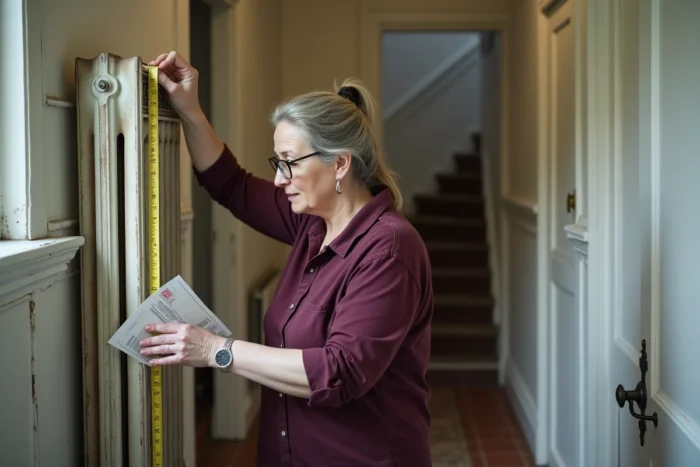
Power per cast iron element: columns, height, and water regime
A cast iron radiator element does not deliver a fixed power. It depends on three parameters: the number of columns (2, 4, or 6), the height of the element, and the water regime of the heating circuit.
Number of columns and exchange surface
The more columns an element has, the greater its exchange surface with the ambient air. A 4-column element produces significantly more watts than a 2-column element of the same height. 6-column models offer even more power per element, but their depth requires a greater clearance from the wall.
Water regime and temperature delta
The catalog power of a cast iron element is given for a specific water regime, usually 90/70 °C with an ambient temperature of 20 °C (delta 50). In a modern low-temperature installation (e.g., 50/30 °C, coupled with a heat pump), the actual power of each element drops significantly.
Therefore, the effective power must be recalculated based on the actual water regime of the installation. Ignoring this point leads to under-sizing the number of elements, and the room remains cold as soon as the outdoor temperature drops.
Cast iron radiator in renovation: the pitfalls of old buildings
In an old house, the power calculation becomes complicated because several factors work against each other.
- High ceiling height: a living room with the same floor area but 3 m high instead of 2.50 m represents a volume to heat that is 20% greater. The W/m² ratio does not capture this difference, but the volumetric calculation does.
- Uninsulated stone or solid brick walls: the loss coefficient G rises sharply, increasing the power needed compared to a home insulated from the inside or outside.
- Single glazing or old double glazing: windows represent a major loss point. Replacing single glazing with high-performance double glazing can significantly reduce the required power of the room.
- Uncontrolled ventilation: unwanted air inlets (open fireplace, worn window seals) increase heating needs without appearing in a simplified calculation.
It is advisable to apply a safety coefficient of about 15% to the result of the volumetric calculation, rather than doubling the margin as some do out of caution. An oversized radiator operates in fits and starts, which degrades comfort and puts more strain on the regulation.
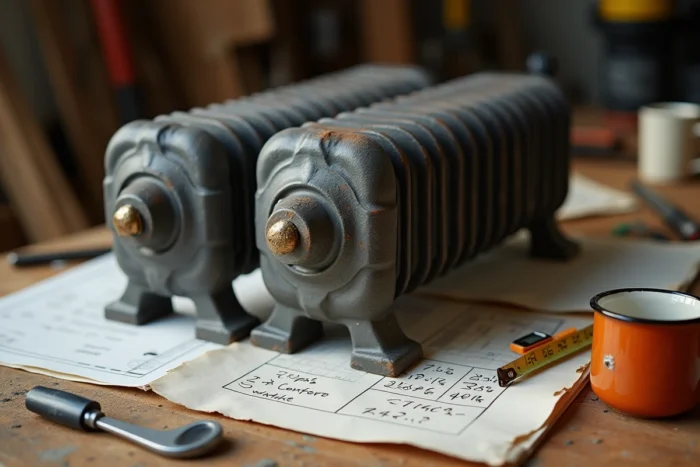
Recent housing and cast iron radiator: adapting the calculation to low losses
In a home compliant with recent thermal regulations, heating power needs drop to around 50 to 60 W/m² instead of the 100 W/m² usually cited for older buildings. Cast iron remains a relevant choice due to its thermal inertia, but the number of elements needed decreases.
Reducing the number of elements prevents overheating due to inertia. A cast iron radiator takes time to heat up, but it also takes time to cool down. In a well-insulated envelope, an overly powerful radiator pushes the temperature beyond the set point before the thermostat shuts off.
Cast iron then continues to radiate for long minutes. Feedback varies on this point depending on the type of regulation installed (classic thermostatic valve or electronic head). Fine regulation, room by room, partly compensates for slight oversizing.
Check the total power of an existing cast iron radiator
For an already installed radiator, we can reconstruct its power by identifying three pieces of information:
- The model or brand (Idéal Standard, Chappée Savane, Floréal, etc.) to find the unit power per element in the manufacturer’s grids.
- The number of elements: count the visible vertical fins on the top of the radiator.
- The number of columns: observe the radiator from the side and count the vertical tubes per element.
We then multiply the unit power by the number of elements. This figure corresponds to the power at the catalog water regime, which must be corrected if the installation operates at a different regime.
When adding or removing elements from an existing cast iron radiator, the recalculation must incorporate the actual volume of the room and the estimated G coefficient of the housing. An experienced heating engineer takes these measurements on-site. An online calculation remains a useful first approximation, not a definitive sizing.