The lily is a bulbous plant from the Liliaceae family. A cut stem placed in a vase generally lacks the underground organ necessary for vegetative regrowth. Therefore, reproducing a lily from a bouquet relies on precise multiplication techniques, rather than simply soaking it in water.
Why a cut lily stem does not root like a traditional cutting
Unlike roses or laurels, the lily cannot be propagated from an ordinary floral stem. The bulb is the storage organ of the lily, and without it, the plant does not have the necessary resources to produce new viable roots.
Placing a stem in water may keep the flower fresh for a few days, but it does not trigger a rooting process comparable to that of other species. The confusion often arises from tutorials that mix genres: the lily is not a philodendron.
For those wishing to plant a lily from a bouquet, the only realistic path involves recovering specific elements from the stem, when they exist: aerial bulbils or, failing that, bulb scales if a basal fragment accompanies the stem.
Aerial bulbils on a lily stem: identifying the right species
Some species of lilies form small round structures in the leaf axils along the stem. These aerial bulbils are tiny bulbs capable of giving rise to a new plant. They are notably observed in Lilium lancifolium (tiger lily) and Lilium henryi.
The problem: the majority of commercial bouquets contain Asian or Oriental hybrids that do not produce visible bulbils. Before any attempt, the stem must be examined carefully.
- Presence of small hard beads, the size of a pea, at the junction between the leaves and the stem: these are exploitable bulbils.
- Smooth stem with no protuberance: propagation by this means is excluded for this specimen.
- Soft or blackened bulbils: they have likely suffered from water stress or a fungal attack, and their survival rate will be very low.
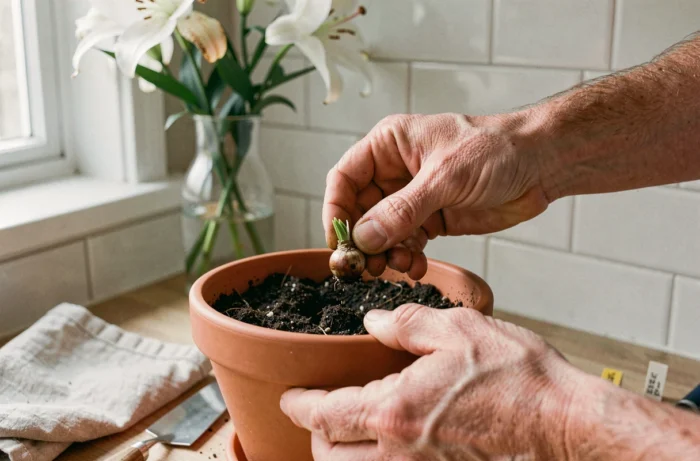
If healthy bulbils are present, gently detach them and place them in a light substrate (a mix of potting soil and sand), about two centimeters deep. Flowering will require several years of cultivation before achieving a mature plant.
Propagation by bulb scales: the horticultural technique for lilies
The most reliable method for multiplying a lily remains propagation by scales. However, it requires having a bulb, even a partial one. In a bouquet, this only happens if the florist has left a fragment of the base of the stem with a few scales still attached, which is rare.
The principle is simple. Each fleshy scale detached from the bulb can, under the right conditions, produce one or more bulbils at its base.
Protocol for cultivating scales
Take external scales that are firm and show no signs of mold. Place them in a bag containing slightly moist vermiculite, then keep the bag at room temperature in a dark place.
After a few weeks, small bulbils will appear at the base of each scale. Once they reach a sufficient size to be handled, transplant them into individual pots in a draining mix: potting soil, sand, and a bit of garden soil.
Soil that is too rich in lime hinders the growth of the lily. The Liliaceae prefer a neutral to slightly acidic, well-drained soil. Ensure that water never stagnates at the bottom of the pot.

Health risks associated with multiplying a bouquet lily
Professional producers resort to micropropagation in laboratories and strict health controls. This level of precaution has a reason: lilies are sensitive to several viruses transmitted by aphids and by contaminated plant material.
Replanting a fragment from a bouquet of unknown origin can introduce an invisible pathogen into your garden. Viral symptoms (mottling on leaves, flower deformation, stunted growth) may only appear in the following season, when the virus has already spread to neighboring bulbs.
- Always isolate the new plant from other bulbs for at least one full season.
- Monitor for the appearance of stripes or unusual spots on the foliage the following spring.
- Immediately eliminate any suspicious plants to protect the rest of your crop.
This health constraint explains why nurserymen generally advise against propagation from uncertified material. The result obtained by sowing (if seeds are collected) will also show significant genetic variability, with no guarantee of recovering the color or shape of the original bouquet lily.
Soil, exposure, and timing: the conditions for successful planting
Whether the bulbil comes from scales or bulbils, the cultivation requirements remain the same. The lily is preferably planted in spring or autumn, when temperatures remain mild. Planting in the full summer heat is not recommended: the bulb risks dehydration.
Choose a sunny location with the base in the shade, a classic principle for Liliaceae. A light mulch at the base of the stem protects the bulb from overheating while retaining moisture.
Pot or open ground cultivation
In pots, use a container at least twenty centimeters deep with effective drainage at the bottom (clay balls or shards). In open ground, plant the bulb at a depth equivalent to two to three times its height, in loosened and not waterlogged soil.
Routine maintenance is limited to moderate watering during growth and placing a stake when the stem reaches a sufficient height to bend under the weight of the flowers.
Attempting to reproduce a lily from a bouquet remains an exercise in patience, with a success rate much lower than purchasing a certified bulb. However, the process has a real educational interest, and the few plants that reach maturity after two or three seasons offer a satisfaction that shortcuts do not provide.