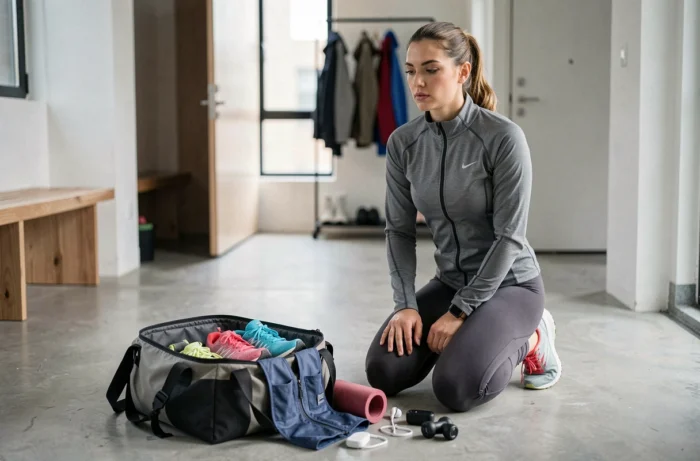
A knee that pulls after a running session, a shoulder that locks at the end of a weightlifting circuit: most of the time, the problem doesn’t come from the program but from what you’re wearing or using. The essential equipment for practicing a sport varies according to the discipline, intensity, and playing surface, and choosing them correctly affects both safety and the pleasure experienced.
Sports Shoes: The First Filter Before Everything Else
On a synthetic field, a gym floor, or a forest trail, the sole works differently. Wearing running shoes on a badminton court means slipping on every lateral push. Conversely, gym shoes on wet asphalt wear out in a few weeks and provide no cushioning.
The central criterion is the cushioning suited to the surface and stride. In running, a model that is too rigid for a supinating runner causes pain in the outer knee. In team sports, the high-top design protects the ankle during quick direction changes.
Before relying on a brand or design, one can have their stride analyzed in a specialized store. This allows you to determine if the foot rolls inward (pronation) or outward (supination) and to guide the choice toward the right support category. To discover the equipment on Format Sport, this preliminary step makes every comparison more relevant.
Technical Clothing: What Really Changes Between a Basic T-Shirt and Breathable Material
A cotton t-shirt absorbs sweat, retains it, and ends up feeling heavy against the skin. In fitness or weightlifting, this accumulation of moisture promotes irritation in the armpits and under the sports bra.
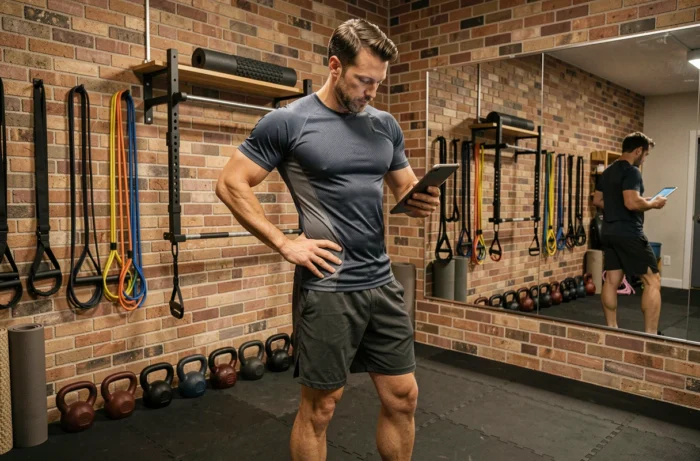
Quick-drying fabrics (technical polyester, synthetic blends with breathable mesh) dry in minutes and limit friction. For women, the sports bra is not a secondary accessory: insufficient support during running or jump rope sessions strains the Cooper ligaments, which do not repair.
On the bottom side, leggings or shorts with flat seams reduce the risk of skin chafing on the thighs during long sessions. Socks, often overlooked, play a concrete role: a reinforced pair at the heel and forefoot limits blisters during repeated cardio sessions.
Guidelines for Choosing Sports Clothing
- Check that the material indicates a moisture-wicking function (often mentioned under the term “moisture-wicking” or “dry” on the label).
- Prefer flat seams in friction areas (crotch, armpits, shoulders) for sessions longer than thirty minutes.
- Adapt compression to the type of effort: an overly compressive garment hinders abdominal breathing during floor exercises like planks or Pilates.
Protective and Safety Accessories According to the Sport Practiced
The question of protection goes beyond just a pair of weightlifting gloves. In cycling and scootering, helmets have become mandatory for children and are strongly recommended for adults on motorized personal transportation devices. A poorly fitted helmet (too loose, strap not tightened) offers barely better protection than no helmet at all.
In racket or ball sports, protective goggles reduce the risk of eye injury, a rarely discussed angle. Squash, for example, exposes the eyes to ball impacts at very close range. Sports goggles with polycarbonate lenses absorb the shock without breaking.
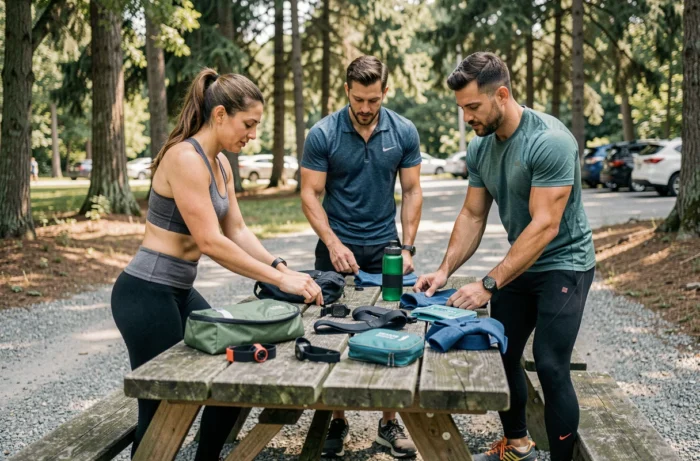
For weightlifting in the gym, a lumbar belt is only useful for heavy movements (deadlifts, loaded squats). Wearing it constantly weakens the deep trunk muscles, which goes against the goal of strengthening.
Fitness and Weightlifting Equipment at Home or in the Gym
Establishing an effective weightlifting or fitness routine does not require a complete arsenal. Three categories of accessories cover the majority of needs.
- A mat thick enough to protect the joints on the floor: models that are too thin transmit the hardness of the floor or tiles to the knees and elbows during push-ups, planks, and abdominal exercises.
- A pair of adjustable dumbbells or two pairs of fixed weights (one light and one moderate): this allows for working both shoulders and biceps or weighted squats without cluttering the space.
- Resistance bands of varying thickness: they add progressive load to bodyweight exercises and serve as a warm-up for the shoulders and hips.
The weight bench, often presented as the centerpiece of a home gym, only makes sense if you regularly practice bench presses or bent-over rows. For cardio-strength oriented sessions, it takes up space without providing a proportional benefit.
Eco-Design of Sports Equipment: What Evolves in Terms of Regulation
The European regulation on the eco-design of sustainable products (ESPR), which came into effect on July 18, 2024, establishes a framework to impose durability and reparability requirements on manufacturers. Textiles are among the priority categories in the Commission’s work schedule, meaning that the information available on the composition and longevity of sports clothing will expand in the coming years.
The possibility of a digital passport for textiles is planned within this framework, but its concrete application will depend on regulatory acts specific to each product category. For athletes, this will ultimately translate into a more detailed label reading, beyond the simple mention of “recycled polyester.” A criterion to keep in mind when renewing your sports wardrobe, especially for high-use items like shoes or bras.
Choosing sports equipment is less about a universal checklist and more about adjusting to one’s actual practice. A pair of shoes suited to one’s stride, clothing that wicks moisture in the right places, and specific protections for one’s sport already cover the majority of needs. The rest is extra comfort, not less performance.