
In France, the terms “bar” and “café” are used interchangeably in everyday language. Both refer to a place that serves drinks, but their spatial organization, business model, and the type of sociability they produce differ significantly.
The counter as a structural marker of the bar
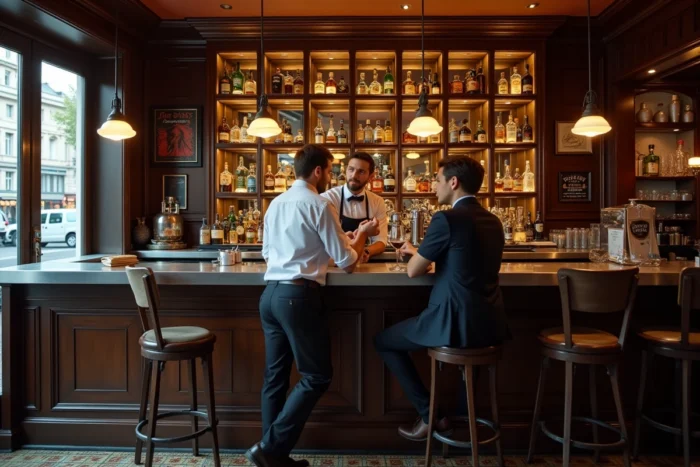
The most concrete distinction between a bar and a café lies in the layout of the place. A bar is organized around its central counter, which structures the entire space. Customers sit facing the person serving, creating a direct, horizontal, almost permanent interaction.
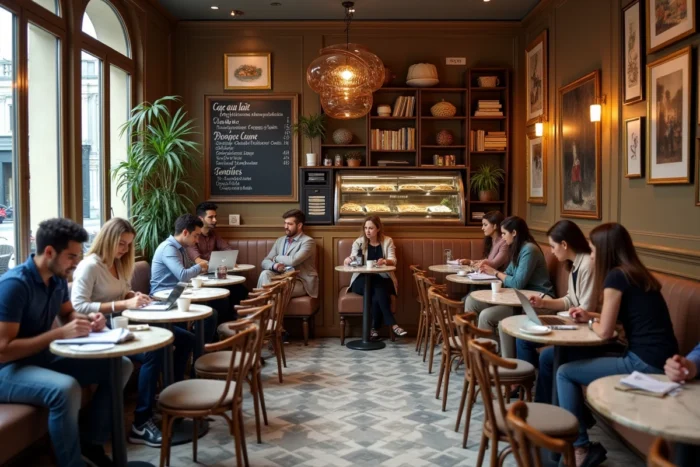
The café, on the other hand, is organized around the room and tables. Service is primarily seated. The person serving moves between the tables, generating a more occasional, more formal relationship.
This difference in social architecture explains why the bar encourages spontaneous conversation among strangers, while the café tends to foster discussion among people who came together. The bar’s counter functions as a semi-public space: one addresses the bartender, but also the neighbor on the stool. Understanding the difference between bar and café starts with this spatial observation, before any question of menu or license.
Economic model: alcohol versus coffee, two margin logics
The star product of the bar is alcoholic beverages. Draft beer, cocktails, spirits: these products generate high margins but are subject to VAT at the normal rate. The operation of a bar is managed through the prime cost, which is the sum of the cost of drinks and payroll.
The traditional café, on the other hand, derives most of its revenue from the sale of hot drinks (espresso, long coffee, tea) and non-alcoholic beverages. Unit margins are lower, but the turnover volume is higher, especially in the morning and during lunch breaks.
Drinks license: the regulatory dividing line
In terms of regulation, a bar that serves alcohol needs a drinks license appropriate to the category of beverages offered. A café that does not serve alcohol can operate without this license, simplifying administrative procedures and reducing legal obligations (display, training, hours).
This regulatory distinction has a direct impact on commercial positioning:
- A bar focuses its menu on cocktails, craft beers, or spirits, with activity concentrated in the evening and on weekends.
- A café relies on a steady flow throughout the day, offering hot drinks, pastries, or light meals.
- A hybrid establishment (café by day, bar by night) must hold the appropriate license and adapt its staff to both types of service.
Sociability and attendance rhythm: two distinct temporalities
The bar and the café do not operate at the same hours, and this difference in timing shapes very different atmospheres. The café opens early, welcoming morning regulars, workers on break, and business meetings. The café is a place for quick passage and daily routine.
The bar, in contrast, comes to life at the end of the day. Attendance increases from happy hour and peaks in the evening. The time spent on-site is longer, consumption is slower, and the atmosphere is more festive or relaxed depending on the type of establishment.
The role of the bartender versus that of the café server
In a bar, the bartender occupies a central position. Their location behind the counter makes them a permanent interlocutor, sometimes a confidant, often the animator of the atmosphere. The job requires skills in mixology, knowledge of products, and the ability to manage the pace of evening service.
In a café, the server moves between the tables. Their role is more functional: taking orders, serving, processing payments. The interaction remains polite but brief. The bartender creates the atmosphere, the café server ensures the flow.
Bar or café: the boundaries blur in hybrid places
For several years, many establishments have blurred the line between bar and café. The concept of “third place” is developing: a space that functions as a café in the morning (coworking, readings, hot drinks), then shifts to a bar in the evening (cocktails, music, events).
This hybridization responds to a simple economic logic: occupying the space throughout the day to maximize revenue. A café that closes at 5 PM leaves its premises empty during the most profitable hours for alcohol sales. A bar that only opens at 6 PM captures no morning revenue.
For the customer, the distinction then becomes a matter of time rather than place. The same establishment can be a café at 9 AM and a bar at 9 PM, with a menu, lighting, and sound ambiance changing throughout the day.
Regulation follows this evolution: the operator must hold the license corresponding to the highest category of beverages they offer, regardless of the time. Transforming a café into a bar in the evening without the appropriate license exposes one to administrative penalties.
The most reliable criterion for distinguishing a bar from a café remains the layout around the counter, the type of beverages that structure the revenue, and the dominant time slot of attendance. Three concrete markers that persist even when brands play on ambiguity.