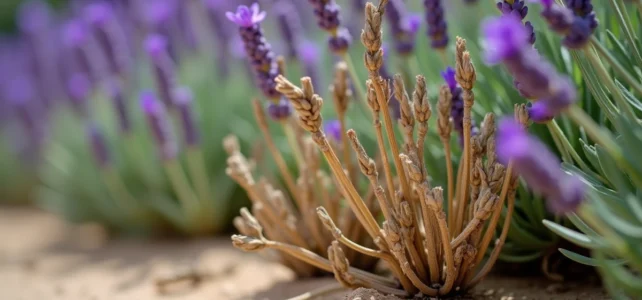
The drying out of a lavender plant often begins with the roots, long before the foliage shows any visible signs. When the stems turn brown or the clump becomes sparse in the center, the underground process is already advanced. Understanding the precise mechanisms that lead to this decline allows for intervention on the right levers, at the right time.
Soil temperature and alternating water stress: the underestimated factor
Lavender tolerates summer drought, but it poorly withstands sudden alternations between heatwaves and violent rain episodes. This scenario, increasingly common in several regions of France, causes alternating water stress that disrupts the root system.
In the Valensole plateau, the Verdon Regional Natural Park documents that agroecological practices (plant cover between rows, more vibrant soil) are being implemented to combat the decline of lavender plants, described as a recurring problem for farmers in recent years. Lavender growers now consider stormwater as an essential resource after prolonged drought episodes.
This phenomenon is not limited to professional fields. In the garden, bare soil around lavender plants accumulates heat on the surface, then receives a storm rain that suddenly saturates the earth. The dry-saturated alternation destroys the fine root hairs that ensure water absorption. The plant seems to lack water even though the soil is moist: this is the classic diagnostic trap.
A mineral mulch (gravel, pumice) limits soil heating in summer and regulates infiltration during sudden rains. This simple lever significantly reduces root thermal stress, much more effectively than compensatory watering.
To delve deeper into the causes of lavender drying, one often needs to look beneath the soil surface rather than at the foliage.
Root rot and phytophthora: differential diagnosis at the collar
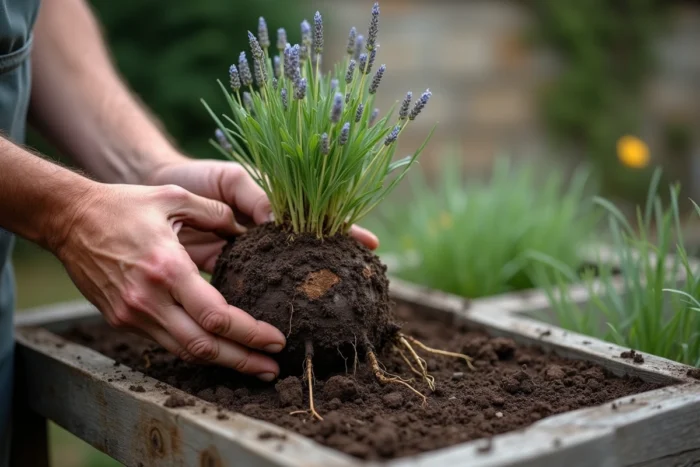
Excess stagnant moisture remains the primary cause of mortality in lavender, both in the ground and in pots. The fungus Phytophthora, naturally present in heavy and poorly drained soils, colonizes the roots as soon as water stagnates for more than a few hours around the collar.
Symptoms to observe on the collar and roots
A blackened and soft collar confirms active rot. Healthy roots are white to light beige, flexible, and branched. As soon as they turn dark brown and detach easily, the plant is affected.
The drying caused by Phytophthora progresses asymmetrically: one side of the clump turns brown while the other remains green for a few weeks. This asymmetry is a reliable marker to distinguish root rot from simple water deficiency, where wilting is homogeneous.
- Black and soft collar to the touch: advanced root rot, the plant is rarely recoverable.
- Stems drying on one side of the clump: strong suspicion of Phytophthora, to be verified by digging up part of the roots.
- Homogeneous drying with gray and soft leaves: more likely a water deficit or overly compact soil.
- Blackening of the lower leaves with sooty deposits: sooty mold, linked to ambient humidity and often associated with the presence of aphids.
Drainage: the only reliable preventive lever
We observe that almost all lavender plants that decline in gardens are planted in clay soil or in pots without sufficient drainage layers. A soil that retains water for more than two hours after rain is incompatible with lavender.
In the ground, planting on a mound or slope remains the safest method. In pots, a substrate composed of equal parts of light potting soil and fine gravel, with a bottom layer of clay balls, prevents stagnation.
Clump aging and lignification: when pruning is no longer enough
Lavender is a plant with a limited lifespan. After several years, the base becomes lignified and the lower parts stop producing new shoots. The center of the clump becomes sparse, the outer stems droop, and the whole gives the impression of a plant drying out when it is simply aging.
An annual pruning after flowering slows down lignification but does not prevent it indefinitely. The basic rule: never cut into old wood, as lavender does not sprout again on bare wood. Pruning each year the upper third of the stems, just above the last green leaves, keeps the clump compact and productive.
When lignification has affected more than half of the base, replacing the plant becomes necessary. We recommend taking cuttings from the still green tips to obtain new plants rather than persisting with an exhausted subject.
Discreet pests: sharpshooter and gall midge in the garden
Articles about drying lavender rarely mention specific pests of this plant. The sharpshooter, a small piercing-sucking insect, weakens the stems by extracting sap. The damage resembles a gradual drying out with no apparent cause.
The lavender gall midge, a small fly whose larvae develop in the stems, causes swelling and localized drying of the affected stems. Stems that dry individually with a swelling at the base point to this pest rather than a fungal disease.
- Presence of small green or yellow insects on the underside of the leaves: sharpshooters, to be treated with diluted black soap spray.
- Visible swellings on the stems, with a tiny exit hole: gall midge, cut and burn the affected stems.
- Cluster of white foam (cuckoo spit): larvae of froghopper, damage generally limited, a jet of water is enough to dislodge them.
The confusion between pest and fungal disease often leads to inappropriate treatments. A careful examination of the stems and the underside of the foliage, with a magnifying glass if necessary, guides the diagnosis before any intervention.
The drying out of a lavender plant rarely results from a single cause. Poorly drained soil, violent climatic alternations, natural lignification, and discreet pests frequently combine. The first useful reflex remains to partially dig up the roots to assess their condition before deciding between rescue and replacement.