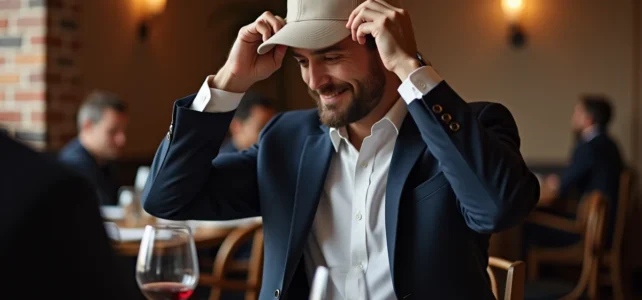
You are seated in a restaurant, cap firmly on your head, and a lingering gaze from your table neighbor makes you uncomfortable. This discomfort has an explanation that goes beyond mere politeness. Removing your cap in a restaurant is part of an ancient code, still active today, that combines respect for the host, comfort for the guests, and a social reading of your attitude.
What your cap communicates to other guests
Before discussing history or rules, one point deserves attention: the cap sends a non-verbal message. Keeping a head covering at the table gives the impression of not truly settling in, of remaining in transit.
In a restaurant, each guest shares a common space. The person sitting across from you first sees the visor, not your eyes. Direct eye contact is the foundation of a shared meal. A cap creates a physical barrier between your gaze and that of your conversation partner.
This is not a matter of fashion or personal taste. It is a signal that those around you instinctively decode: someone who keeps their cap on seems less engaged in the moment. In a professional setting, such as a business lunch, the effect is even more pronounced. Your conversation partner may interpret the gesture as a lack of consideration, even if that was not your intention.
Perception varies across generations. For those over fifty, wearing a cap is disrespectful in a restaurant, with no room for discussion. Among younger people, tolerance is greater, but discomfort often lingers without being expressed.
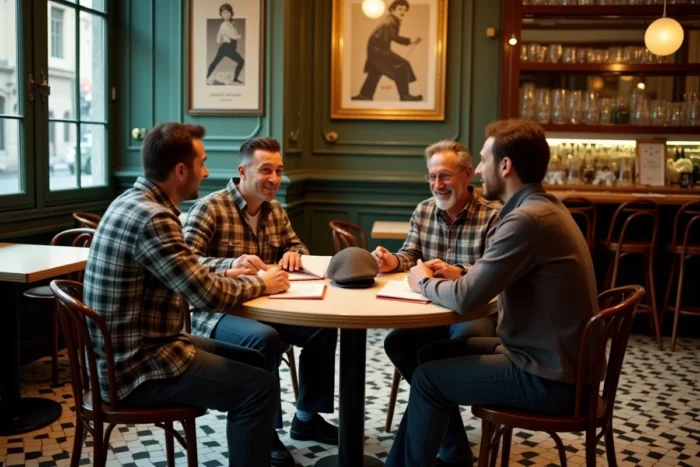
Cap at the table: where does this rule of politeness come from
The act of removing one’s head covering indoors dates back to the Middle Ages. Knights would remove their helmets upon entering a host’s home to show they had no hostile intentions. Uncovering one’s head literally meant: I make myself vulnerable before you, I trust you.
This military practice extended to civilian life over the centuries. Uncovering oneself became synonymous with respect for the host. In high society, etiquette rules became codified. Men were required to remove their hats upon entering a house, a church, or a restaurant. Women, however, were granted exceptions for pinned hats, which were difficult to remove.
Today, the cap has replaced the hat, but the code remains the same in its broad outlines. The dining venue is considered a welcoming space, comparable to a home. Keeping your cap on, in this logic, symbolically refuses the hospitality of the restaurateur.
A rule that applies beyond France
This code exists in most Western countries. In Spain, keeping a cap on while eating is perceived as a lack of education by a large part of the population. In some Southeast Asian countries, the dimension goes even further.
In Vietnam, tourists have been penalized for wearing caps deemed disrespectful in heritage sites, including restaurants located on historical sites. Fines can reach very significant amounts. The issue then goes beyond mere politeness to touch on legal frameworks.
When to remove your cap in a restaurant: specific situations
You may have noticed that some people keep their caps on in a fast-food restaurant without anyone batting an eye, but the same gesture in a fine dining restaurant provokes disapproving looks? Context changes everything.
Here are the situations where removing your cap is expected:
- In a restaurant with table service, regardless of the establishment’s standing. The mere fact of being served by someone creates a welcoming environment where head coverings are removed.
- During a meal at someone’s home, including a barbecue or informal dinner. The host welcomes you: uncovering your head remains a sign of consideration.
- In a dining venue located on a heritage, religious, or official site. Dress codes may be reinforced by local regulations.
Exceptions exist. On a sunny terrace, keeping a cap on for protection is perfectly acceptable. In a food court or fast food without table service, the norm is much more relaxed.
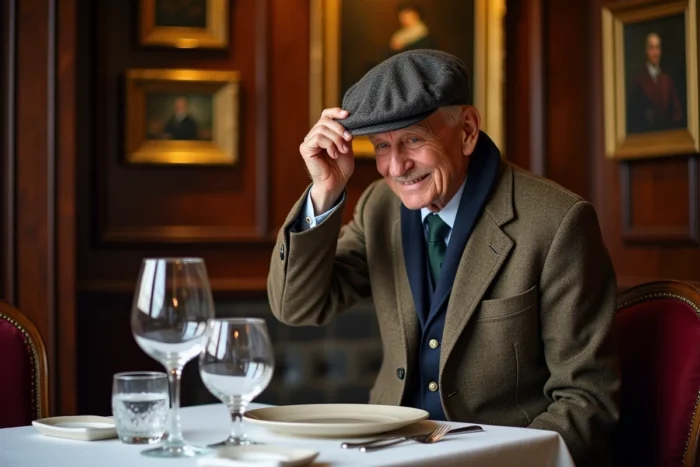
Cap removed: where to place it and how to manage the gesture
A common concern: you remove your cap, and you don’t know what to do with it. Placing it on the table next to your plate is not ideal. It takes up space and can come into contact with food or utensils.
The cap should be placed on your knees, in a bag, or at the coat check. If the restaurant has hooks or hangers under the banquette, that’s the perfect spot. Some high-end establishments offer a coat check: take advantage of it.
Another frequent issue: flattened hair. This is the most commonly cited reason for keeping a cap on. A few gestures are enough. Run your hand through your hair as you remove the cap. If you know you will be dining outside, avoid wearing the cap too tightly in the hour leading up to the meal.
The special case of medical reasons
Some people wear head coverings for health reasons: alopecia, medical treatment, scars. In these situations, no rules of etiquette apply. Respect goes both ways. Restaurateurs and guests generally understand the situation without the need for justification.
Cap and dress code in restaurants: what establishments expect
More and more restaurants display a dress code in their welcome conditions. The cap is sometimes explicitly listed among the items to be removed or avoided.
Fine dining restaurants and establishments located in upscale hotels systematically apply this rule. A maître d’hôtel may politely ask you to remove your cap upon being seated. This is neither a judgment nor an humiliation: it is the application of a dress code, just like the prohibition of flip-flops or swim shorts.
In brasseries and bistros, tolerance varies. The simplest approach is to observe other customers upon arrival. If no one is wearing a head covering, remove yours.
The tradition of removing one’s cap in a restaurant is not arbitrary. It is based on a simple mechanism: showing those around you that you are fully present, respectful of the place and the person facing you. The gesture takes three seconds. The impression it leaves lasts throughout the meal.