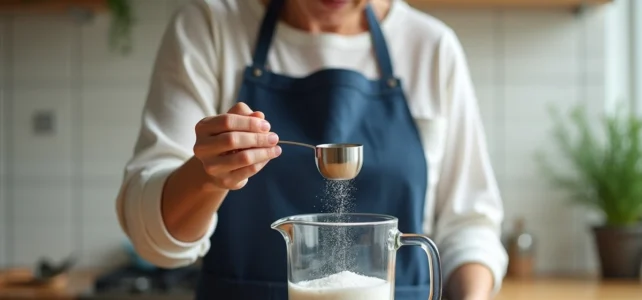
Salting a liter of cooking water seems simple, and most guides stop at a single recommendation. The problem arises when the recipe includes bouillon cubes, parmesan, bacon, or soy sauce, as the salt in the water adds to that already present in the ingredients. Therefore, the salt dosage for a liter of water depends as much on what you put in it as on the amount of water itself.
The hidden salt in ingredients skews the initial dosage
Most recipes instruct to salt the water without mentioning the sodium content of the rest of the preparation. A bouillon cube, a slice of bacon, or a handful of olives already contribute a significant amount of salt. If you add the usual amount to the water, the final dish far exceeds the threshold of pleasant taste.
The mechanism is physical: under the effect of heat, salt migrates from the water to the food. When that food itself contains sodium, the internal concentration rises faster than expected. This phenomenon of cumulative over-salting makes a parmesan risotto or anchovy pasta too salty even though the water seemed properly dosed.
To master this point, you need to think in terms of the total salt in the dish and not just the salt in the water. Before salting your liter of water, list the salty ingredients in the recipe. If the list includes more than two high-salt items (aged cheese, charcuterie, capers, fermented sauce), reduce the salt in the water by half or do not salt at all. The salt dosage in cooking is better thought of globally rather than step by step.
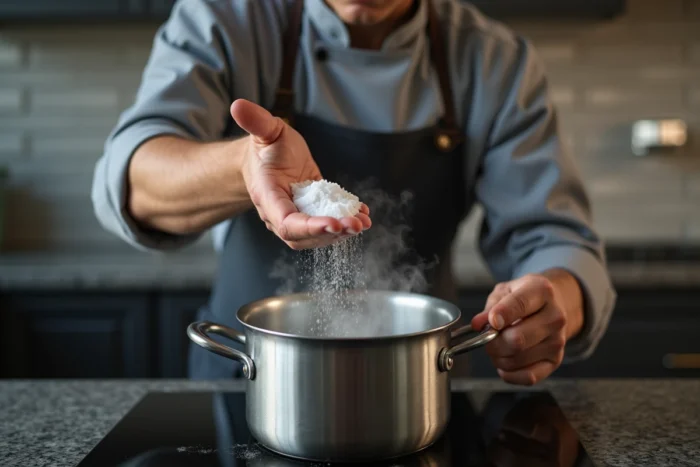
Basic guideline: measure salt by weight rather than by spoon
The common recommendation hovers around one to two teaspoons of salt per liter of water. The issue is that a teaspoon of fine salt and a teaspoon of fleur de sel do not weigh the same. The granularity, the shape of the crystals, and the moisture content of the salt change the actual weight for the same volume.
The recent trend in cooking leans towards weight measurement with a precision scale. Weighing the salt removes the approximation related to crystal size and makes the result reproducible from one time to the next.
Adjusting the weight according to the food
Not all foods react the same way to salted water. Pasta, which absorbs some of the cooking water, requires a bit more salting for the flavor to penetrate the dough. Green vegetables, on the other hand, need less salt because their short cooking time limits penetration, and their own flavor is often sufficient.
- Pasta and gnocchi: standard salting, as the starch absorbs the water and the salt with it. Water that is too bland produces flat-tasting pasta.
- Potatoes: moderate salting, as the dense flesh absorbs salt slowly, and excess is difficult to correct after cooking.
- Green vegetables (beans, broccoli): light salting, as the short cooking time does not allow the salt to migrate deeply. The salt mainly acts on the surface.
- Legumes (lentils, chickpeas): experiences vary on this point. Some cooks salt at the beginning of cooking for flavor, while others do so at the end to avoid toughening the skin.
The salinity of the water also influences the final texture of the food, not just its taste. Properly salted water helps pasta develop a slightly rough surface that holds sauce better.
Concentrating cooking: when salt multiplies on its own
A phenomenon that general guides rarely address concerns long cooking times or reductions. When you reduce a broth, sauce, or stock, the water evaporates but the salt remains. The concentration of salt therefore gradually increases without you adding anything.
The trap is common with soups, braises, and sauce bases. You taste at the beginning of cooking, the salinity seems correct, then after an hour of reduction, the dish becomes too salty. Salting at the end of cooking avoids this trap in preparations that reduce.
Progressive adjustment method
The most reliable practice is to salt in stages rather than all at once. Experienced cooks add a small amount of salt at the beginning to start the migration into the food, then taste and adjust at the end of cooking.
This approach works particularly well for sauced dishes, stews, and oven cooking. For simple pasta cooking water, a single salting at the beginning remains suitable, as there is no reduction.
- Short cooking without reduction (pasta, blanched vegetables): salt the water before adding the food.
- Long cooking with reduction (stock, soup, braise): salt lightly at the beginning, adjust in the last minutes.
- Mixed cooking (risotto, paella): salt the base liquid moderately, taste halfway through cooking, adjust when the liquid has been absorbed.
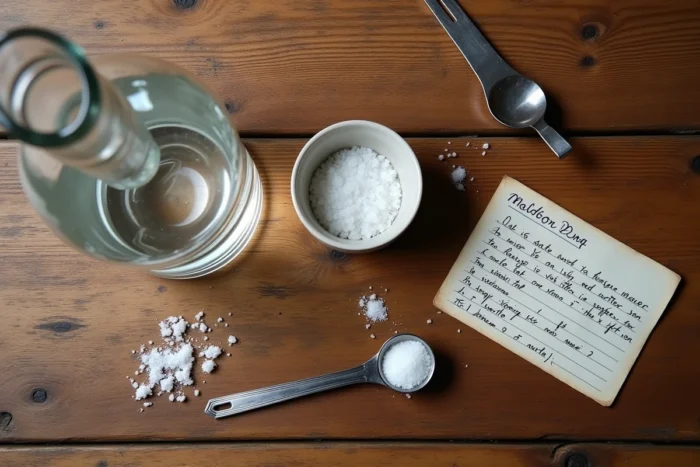
Fine salt, coarse salt, fleur de sel: the type of salt changes the perceived dosage
The choice of salt has a direct impact on how we measure. Unrefined natural salt contains minerals (magnesium, potassium, calcium) that slightly alter the taste perception. Fleur de sel, which is more humid and has irregular crystals, dissolves more slowly and gives a softer salinity sensation at equal volume.
For cooking water, coarse salt or standard fine salt remains the most suitable: they dissolve quickly and distribute evenly. Fleur de sel is reserved for final seasoning, as a finishing touch, where its crunch and subtle flavor are better perceived.
Refined salt seasons more directly and uniformly than raw sea salt. Switching from one to the other without adjusting the amount can explain variations in results from one recipe to another. When changing salt types, the first cooking serves as calibration: taste, note, and adjust the next time.
The right salt dosage for a liter of water does not exist as a universal number. It depends on what you are cooking, what the recipe already contains, the type of cooking, and the salt used. Weighing rather than measuring by volume, listing the sources of sodium in the recipe, and tasting before re-salting remain the three reflexes that prevent over-salting, much more reliably than a fixed rule.