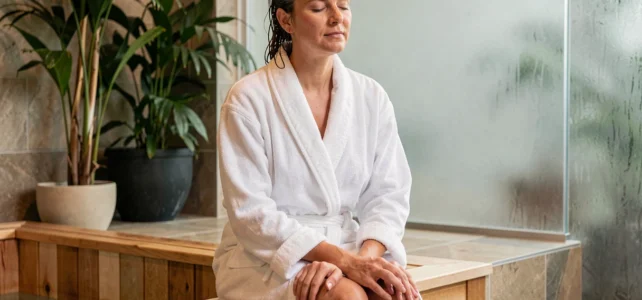
Fifteen minutes in a hot tub may seem too short to produce anything tangible. However, the body reacts from the very first minutes of immersion in hot water: the heart rate adjusts, blood vessels dilate, and the nervous system shifts into recovery mode. A 15-minute spa session is enough to trigger a cascade of physiological responses that recent research is beginning to document accurately.
What the body initiates in less than a quarter of an hour in hot water
Have you ever noticed that pleasant feeling of heaviness after a few minutes in a hot bath? It’s not just subjective relaxation. The warmth of the water (around 37 to 39 °C) causes peripheral vasodilation: blood flows more easily to the muscles and skin.
This mechanism is accompanied by a moderate increase in heart rate, comparable to that of brisk walking. The heart works harder without joint impact, which has led some researchers to refer to immersion in hot water as “passive thermal therapy.”
At the same time, the hydrostatic pressure exerted by the water on the body reduces the load felt by the joints. For someone suffering from chronic back or knee pain, these few minutes of immersion provide immediate mechanical relief. The benefits of a 15-minute spa session rely on this combination of heat, buoyancy, and circulatory stimulation, not on the duration itself.
Stress reduction and cortisol: why 15 minutes make a difference
Chronic stress translates into a consistently high cortisol level. Hot water acts on the autonomic nervous system by promoting the activation of the vagus nerve, which controls the parasympathetic branch, the “rest and digest” part of the nervous system.
Specifically, after about ten minutes of immersion, heart rate variability increases. This is a reliable indicator of the body’s ability to shift out of alert mode. The higher this variability, the better the nervous system manages transitions between effort and recovery.
This shift explains why a short session at the end of the day improves sleep quality. The body doesn’t fall asleep better because it is “tired” from the bath, but because the nervous system has received a signal to de-escalate. The production of endorphins triggered by the heat reinforces this effect.
When a short duration becomes an advantage
The Taiwanese health authorities, through the Health Promotion Administration, explicitly recommend not exceeding 15 minutes per session for thermal baths. This limit is not arbitrary: beyond this, the risk of dehydration and a drop in blood pressure increases, especially in hypertensive or diabetic individuals.
A short session thus limits side effects while capturing most of the benefits. The Taiwanese recommendation also specifies keeping the water below 40 °C for individuals with cardiovascular conditions and staying hydrated before and after immersion.
- Recommended temperature: between 37 and 39 °C for a healthy adult, below 40 °C in cases of hypertension or diabetes
- Hydration before and after the session to compensate for fluid loss due to sweating
- Avoid abrupt hot-cold alternation in cases of cardiovascular fragility
Spa and cognitive functions: a recent research area
The effect of a short spa session on the brain goes beyond mere perceived relaxation. Recent research, particularly those reported by Professional Beauty, explores the link between thermal therapy through hot tubs and cognitive health.
The hypothesis being tested is based on the improvement of cerebral perfusion. By dilating blood vessels, heat increases blood flow to the brain. This phenomenon could, in the long run, be relevant for preventing age-related cognitive decline.
These results remain preliminary. However, they show that the benefits of a spa session are not limited to muscle pain or stress. The neurological dimension opens a field that typical spa wellness content rarely addresses.
A parallel with the Finnish sauna
The large Finnish study KIHD (Kuopio Ischaemic Heart Disease Risk Factor Study) showed an association between the frequency of sauna sessions and a reduction in cardiovascular risk. The underlying mechanism, passive thermal therapy, is comparable to that of a hot tub.
The spa replicates some of the sauna’s effects with a gentler thermal constraint, thanks to the water that regulates the body’s temperature rise. For those who do not tolerate the dry heat of the sauna well, the spa offers a more gradual alternative.
Integrating a short spa ritual into your week: what really matters
Regularity is more important than duration. A daily 15-minute session produces cumulative effects on stress reduction and sleep quality that two long sessions per month do not replicate.
You don’t need an elaborate protocol. Hot water, jets, and silence are sufficient. Additions (essential oils, chromotherapy) are about comfort, not physiology.
- Prefer a session at the end of the day, at least an hour before bedtime, to allow the body temperature to naturally cool down
- Maintain regular hydration: a large glass of water before, another after
- In winter, the temperature difference between the ambient air and the water enhances the feeling of relaxation and vasodilation
- Respect a gap of at least four hours between two sessions if you practice multiple baths in a day
Fifteen minutes are enough to activate the body’s recovery mechanisms. The trap would be to believe that staying longer would provide more benefits. Beyond the quarter-hour, physiological gains plateau while risks (dehydration, hypotension) increase. The short session is not a compromise; it is the format that recent research and health recommendations validate.