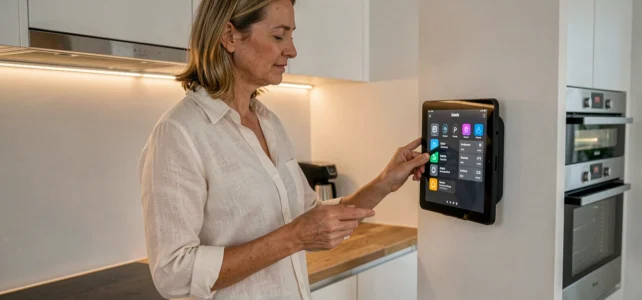
Home automation encompasses a set of technologies that control lighting, heating, shutters, or security of a home from a centralized interface. Comparing these home automation systems requires looking beyond the comfort advertised by manufacturers: communication protocols, actual consumption of connected devices, and, recently, European regulatory obligations regarding cybersecurity change the game for any home automation project.
Home Automation Protocols: Compatibility and Range Compared
The choice of a protocol determines reliability, signal range, and the ability to coexist with connected devices from different brands. Three families dominate the residential market, each with distinct technical characteristics.
| Protocol | Network Type | Typical Indoor Range | Interoperability |
|---|---|---|---|
| Z-Wave | Mesh (sub-GHz) | Good wall penetration, low data rate | Cross-certification between manufacturers |
| Zigbee | Mesh (2.4 GHz) | Medium, sensitive to Wi-Fi interference | Large ecosystem, but profiles can be fragmented |
| Wi-Fi / Thread | Star or mesh (native IP) | Depends on the router, higher consumption | Thread unifies via Matter, still being deployed |
A mesh network (Z-Wave, Zigbee) enhances coverage: each connected device relays the signal to its neighbors. The more devices there are, the more stable the mesh becomes. In contrast, a 100% Wi-Fi system places more demand on the home router’s bandwidth and consumes more energy per sensor.
The Matter standard, supported by Apple, Google, and Amazon, promises to enable communication between these protocols. Its actual adoption remains gradual: not all existing home automation devices will receive a compatible update.
To keep up with the evolution of these technologies and find useful information on Bricotronique, it is relevant to check Matter compatibility before each purchase.
Cyber Resilience Act: What European Regulation Changes for Home Automation Devices
Most home automation guides overlook the regulatory dimension. The regulation (EU) 2024/2847, known as the Cyber Resilience Act (CRA), modifies the obligations of any manufacturer marketing a product with digital elements in the European market.
Adopted on October 23, 2024, and coming into force on December 10, 2024, this text directly targets home automation boxes, sensors, connected locks, cameras, and thermostats. Two deadlines structure the timeline.
- September 11, 2026: obligation for manufacturers to report actively exploited vulnerabilities and serious incidents, including for products already marketed.
- December 11, 2027: full application of significant requirements, including “security by design,” secure updates, encryption, and unique device identity. The CE marking will now include cybersecurity considerations.
- Unlike the NIS2 directive, which targets essential services, the CRA applies directly to physical products, which includes every sensor or actuator installed in a connected home.
For individuals, this means that equipment purchased after 2027 must guarantee security updates for their entire announced lifespan. A connected thermostat abandoned by its manufacturer after two years will no longer comply with the CRA.
Concrete Impact on Choosing a Home Automation System
Prioritizing an ecosystem whose manufacturer publishes a clear support policy becomes a purchasing criterion as crucial as price or compatibility. Open-source platforms like Home Assistant, which do not rely on proprietary cloud services, offer an alternative where the user controls updates without depending on a manufacturer’s commercial decision.
Actual Energy Consumption of a Home Automation Installation
Home automation is often presented as a lever for energy savings. The data deserves to be nuanced according to the type of equipment controlled.
Heating represents the area where measurable gains are most evident. A connected thermostat that adjusts the temperature room by room according to the actual occupancy of the home significantly reduces consumption compared to a fixed hourly schedule. Zone-by-zone control avoids heating unoccupied rooms, which constitutes the main source of savings.
LED lighting controlled by presence detection eliminates forgetfulness. A hallway equipped with a connected sensor no longer stays lit all night. However, the home automation box itself, the Zigbee hub, repeaters, and security cameras operate continuously and add a permanent standby consumption to the household.
Net Energy Balance: What Shifts the Calculation
The gain depends on the number of devices controlled compared to the number of connected devices in standby. An installation that automates only two lamps and a roller shutter via a box, three sensors, and a voice assistant may consume more in cumulative standby than it saves in lighting.
Conversely, a house that centralizes heating, shutters, and lighting from several rooms on a single hub significantly offsets the consumption of the home automation system itself. The tipping point generally occurs when the installation controls at least heating or air conditioning.
Home Security and Limits of Connected Systems
Cameras, opening detectors, and connected locks constitute the second reason for adopting home automation after comfort. Their effectiveness relies on two often underestimated conditions.
The first is the reliability of the internet connection. A network outage disables remote alerts if the system does not have a backup module (SIM card, local storage). The second concerns the attack surface: each device connected to the home network is a potential entry point. The CRA aims to reduce this risk, but devices manufactured before 2027 will not be covered by its requirements.
Ensuring that each camera or connected lock has regularly updated firmware, video stream encryption, and two-factor authentication remains the best precaution in the short term, regardless of the upcoming regulatory framework.
Home automation becomes more relevant when it relies on a protocol suited to the home, a sufficient number of controlled devices to justify the system’s consumption, and devices from manufacturers that commit to long-term security support. The timeline of the Cyber Resilience Act, with its deadlines of September 2026 and December 2027, now provides a concrete benchmark for assessing the sustainability of each home automation investment.