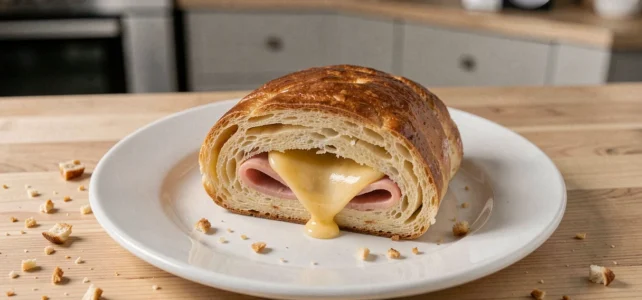
A frozen breaded cordon bleu presents a trap that the microwave amplifies: the golden crust gives the illusion of a precooked product while the meat may remain raw in the center. The documented cases of Salmonella by the CDC in 2021, linked to microwave-cooked frozen breaded chicken products, confirm that the cooking time issue goes beyond mere taste comfort.
Mastering the cooking time of cordon bleu in the microwave is as much about food safety as it is about texture.
Internal temperature and safety: the threshold that the microwave struggles to guarantee
The USDA and Health Canada recommendations converge on a non-negotiable point: a cordon bleu must reach a minimum internal temperature of 74 °C to eliminate pathogens. The microwave heats by molecular agitation of water, creating hot and cold spots in the food. In a thick product like a cheese-stuffed cordon bleu, the temperature difference between the center and the periphery can exceed several tens of degrees.
A probe thermometer remains the only reliable tool. Insert the probe into the center, at the thickest part, after cooking. If the probe does not read 74 °C, return to the microwave in twenty-second increments. We recommend never relying on the exterior appearance: a breaded product may look scorching on the surface while remaining lukewarm in the center.
This problem worsens with cordon bleus labeled “raw breaded.” Their golden crust mimics a precooked product, but the meat has not been cooked before freezing. The microwave alone does not produce the Maillard reaction necessary to cook the breading. It heats the meat unevenly while softening the coating.
Power setting and sequencing: the method that changes the outcome
Mastering the cooking time of cordon bleu in the microwave first requires reducing the power. At full power (900 W or more), the outside of the cordon bleu overheats while the center remains cold. Lowering to 50% of the nominal power extends the total time but allows for more uniform heat distribution.
The protocol we observe as the most reliable breaks down into two distinct phases in the microwave, before any external finishing.
- Controlled defrosting phase: place the cordon bleu on a plate with a paper towel, start the defrost function for one to two minutes depending on the weight. The goal is to bring the center above 0 °C without starting the cooking process.
- Temperature rise phase: switch to medium power, heating in one-minute intervals while turning the cordon bleu between each cycle. Two to three cycles are sufficient for a standard product.
- Rest time: let it rest for thirty seconds after the last cycle. The residual heat continues to rise in the center, reducing the thermal gap.
This sequencing avoids the classic flaw: molten cheese that bursts through the breading while the meat remains barely warm on the periphery.
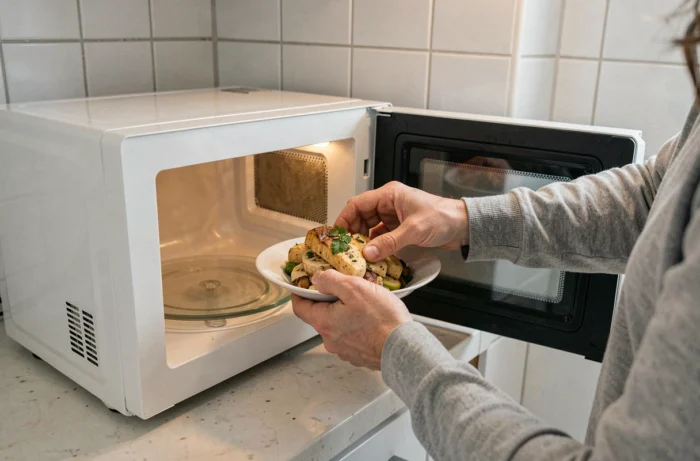
Crunchy finish after microwave: skillet, oven, or air fryer
The microwave does not crisp anything. Electromagnetic waves excite water molecules, producing steam. This steam softens the breading instead of browning it. A cordon bleu taken out of the microwave will always be soft on the surface, regardless of the cooking time.
The solution involves a hybrid method. The microwave ensures the internal temperature rise, then a second device manages the crispiness.
Skillet finish
Heat a skillet with a drizzle of oil over high heat. Sear the cordon bleu for one to two minutes on each side. The breading becomes crunchy again, and the cheese remains melted. This method is suitable for one or two cordon bleus.
Oven finish
Preheat the oven to broil. Place the cordon bleus on a rack (not a tray, to avoid condensation underneath). Four to five minutes under the broiler is sufficient. The dry heat from radiation restores crunchiness to the breadcrumb without drying out the meat, which has already been cooked in the microwave.
Air fryer finish
The air fryer gives the best result in finishing after the microwave. The circulation of hot air dries the surface of the breading in about three minutes, without adding fat. We find that this combination of microwave followed by air fryer replicates the result closest to traditional oven cooking, reducing the total time by half or two-thirds.
Common mistakes that ruin microwave cooking
Some habits systematically degrade the result, even with good sequencing.
- Stacking multiple cordon bleus: the waves do not penetrate evenly when products overlap. Always arrange the pieces in a circle around the edge of the turntable, never in the center (dead zone in most microwaves).
- Using a closed container or airtight plastic wrap: trapped steam makes the breading soggy even faster. A paper towel placed on top absorbs excess moisture without creating a steamer effect.
- Cooking a raw frozen cordon bleu directly at full power without prior defrosting: this is the exact scenario for documented Salmonella contamination. Defrosting before cooking is not optional for raw breaded products.
- Neglecting the resting time: cutting the cordon bleu immediately after microwaving releases the melted cheese and dries out the meat. Thirty seconds of patience redistributes the heat.
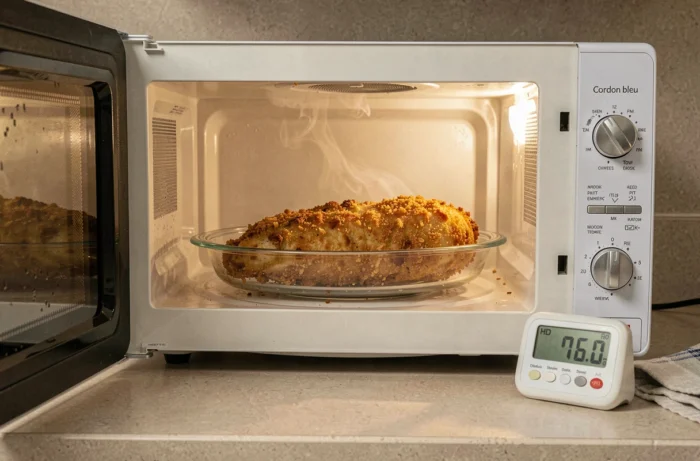
Precooked or raw frozen cordon bleu: adjust the time to the type of product
The distinction between a precooked cordon bleu and a raw breaded cordon bleu radically changes the protocol. A precooked product requires only reheating: the meat has already reached safety temperature at the factory. The microwave is then sufficient to raise the temperature, and the finishing remains a matter of texture choice.
A raw breaded product requires complete cooking. The microwave can contribute, but it does not replace conventional cooking for a raw frozen product. The packaging usually states “cook before consumption” or “raw breaded product.” Reading this mention before choosing a method avoids unpleasant health surprises.
For a precooked cordon bleu, the combination of low-power microwave followed by air fryer or skillet remains the fastest. For a raw product, the traditional oven or covered skillet with extended cooking remains safer than the microwave, even with a thermometer.