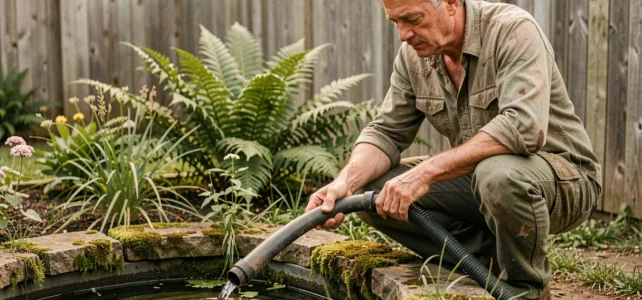
Siphoning remains the reference technique for emptying a garden pond without a pump, but its effectiveness depends on parameters that most guides overlook: actual elevation, pipe diameter, nature of the bottom sludge, and regulatory framework during water restriction periods.
Siphoning a garden pond: technical parameters that condition the flow rate
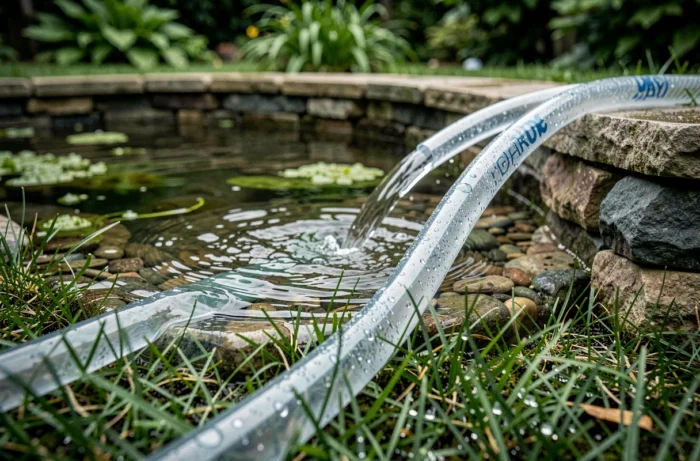
The physical principle of the siphon relies on the difference in atmospheric pressure between the entry point (in the pond) and the exit point (downhill). Without sufficient elevation, the siphon does not start or stops. We recommend a minimum differential of 30 cm between the water surface and the outlet to achieve a steady flow.
The diameter of the pipe radically changes the duration of the operation. A standard 15 mm diameter garden hose is suitable for a small ornamental pond. For a larger volume, switching to a 25 mm pipe divides the draining time by a significant factor. Beyond 32 mm, priming at the mouth becomes difficult: you must then fill the pipe completely before submerging it, sealing both ends.
Priming is the critical point. Three techniques work depending on the available equipment:
- Direct mouth suction on a short pipe (less than 3 m): quick, but risks ingesting water loaded with bacteria and organic matter.
- Complete filling of the pipe at the faucet, then sealing both ends before placement: the most reliable method for lengths over 5 m.
- Total immersion of the pipe in the pond to expel air, then slow extraction of one end towards the low point: requires a flexible pipe and a sufficiently deep pond to submerge the entire length.
Once primed, the siphon operates as long as the submerged end remains below the water surface. When the level drops, the pipe must be repositioned in the deepest area to avoid air intake that breaks the siphon.
We observe that for easily emptying a pond without a pump, the choice of the drainage point is as important as the pipe itself: a natural slope towards a flowerbed, a ditch, or a stormwater catch basin accelerates the process and prevents downstream stagnation.
Managing sludge and bottom residues without mechanical suction
The siphon evacuates clear water but leaves the sediments. This is the point that most so-called “simple” methods forget. The sludge accumulated at the bottom of a garden pond, composed of decomposed leaves, fish droppings, and algae residues, forms a dense substrate that gravity alone does not move in a small diameter pipe.
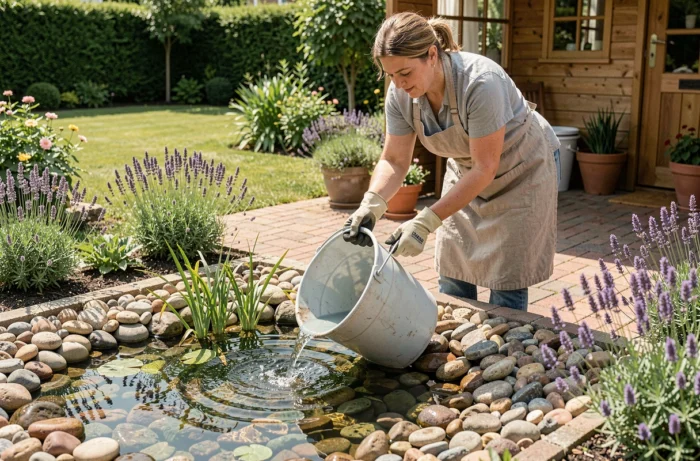
To extract this sludge without a pump or vacuum, the most direct method remains manual scooping once the water level is low enough. A bucket and a flat shovel allow scraping the bottom of the liner or preformed shell without puncturing it.
If the pond contains fish or aquatic animals, we recommend transferring them to a temporary container filled with pond water before going below one-third of the volume. The concentration of nutrients and ammonia increases rapidly as the volume decreases, which can cause fatal stress for the wildlife.
Submerged or semi-submerged aquatic plants (water lilies, marsh irises, reeds) should be removed with their basket and kept in a shaded container. They must be returned to the water within 48 hours to avoid root desiccation.
Drought restrictions and pond draining: a regulatory framework to check
Since recent summers, many French departments placed under Alert, Enhanced Alert, or Crisis levels impose decrees that prohibit not only filling but also draining private ponds and swimming pools over 1 m³. These texts often equate a large garden pond to a “private pond.”
Siphoning water into the garden or a ditch may therefore be illegal during these periods, even without a pump. The fine incurred can reach 1,500 euros for an individual. Before any draining, we recommend consulting the applicable prefectural decree, accessible on the prefecture’s website or through the Vigieau service.
Moreover, the evacuated water must never directly join a natural watercourse if it contains chemical treatments (anti-algae, mosquito control products) or high concentrations of organic matter. Discharging into a soakaway, a phytoremediation area, or a stormwater network remains the compliant solution in most cases.
Alternatives to siphoning for a pond without usable elevation
On flat terrain, classic siphoning becomes ineffective. Two alternative methods are worth knowing.
The first involves digging a temporary receiving hole deeper than the bottom of the pond, in immediate proximity. This hole artificially creates the necessary elevation for the siphon. The collected water can then be eliminated by evaporation, absorption into the soil, or manually evacuated.
The second utilizes the principle of scooping with a bucket and gradual transfer. This method is slow but requires no specific equipment. For a pond of a few hundred liters, expect one to two hours of work. Beyond that, physical fatigue makes the operation unrealistic without assistance.
A complete cleaning of a pond is ideally scheduled in autumn, after the leaves have fallen and before frost. This period limits thermal stress on wildlife, reduces algae proliferation related to heat, and allows the pond to be refilled before the following spring, giving the aquatic ecosystem time to rebalance.