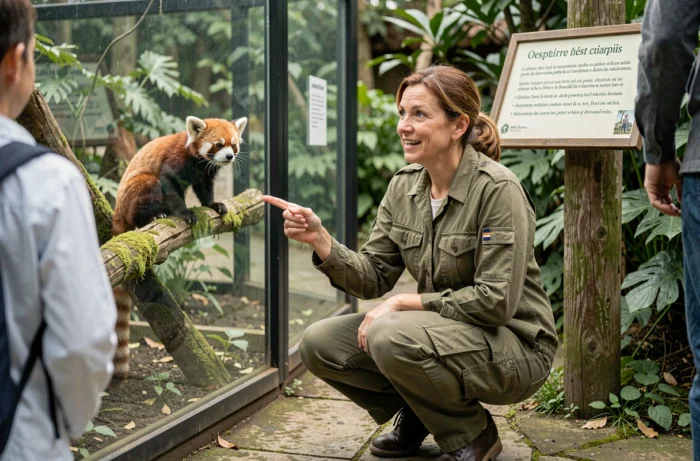
France has over a hundred animal parks, zoos, aquariums, and educational farms spread across the entire territory. Locating these establishments on an interactive map allows filtering by region, type of facility, or species present, rather than consulting unmanageable alphabetical lists.
Conservation Programs and Networks Among French Zoos
A location map becomes truly useful when it goes beyond simple geographic identification. French animal parks do not operate in isolation: animal transfers rely on European genealogical tracking. EEP programs, coordinated by EAZA, maintain individual and family records to organize movements and maintain genetically viable populations.
Visualizing these establishments on a map helps to understand the connections between them. A Breton zoo can send a primate to a Provençal park because the EEP registry identifies a need for genetic diversity in the captive population of the south. These cooperations remain invisible when one only has a list of names and addresses.
The Zooparc de Beauval, for example, participates in a European campaign led by EAZA on wetlands, which includes radio tracking and habitat restoration. This type of commitment transforms a zoo visit into a gateway to concrete biodiversity issues. By identifying on the map of French zoos on Poupala the establishments involved in these programs, planning an outing becomes more meaningful.
Animal Welfare: What the Evolution of Animal Parks Reveals
The number of species displayed is no longer the prestige criterion it once was. La Palmyre, on the occasion of its sixtieth anniversary, announced its intention to voluntarily reduce the number of animals housed to improve living conditions in a limited space. This decision illustrates a shift in priorities, from visible diversity to the quality of individual habitats.
This change in philosophy has direct consequences on what visitors observe. Enclosures are expanding, behavioral enrichments are multiplying, and some species are disappearing from collections in favor of better comfort for those that remain. A park with thirty species in large spaces offers a richer experience than an establishment that crams in double that number.
The Risk After Closure
The zoo of Trois Vallées, in Tarn, closed to the public for several years and then targeted by an administrative closure, still had many animals to transfer. Authorities reported shortcomings in safety and welfare, while the placement of animals proves long and complex.
This case reminds us that the closure of an animal park does not end responsibilities towards the animals. Transferring a feline or a primate to another establishment requires agreements between facilities, health checks, and sometimes months of waiting. An interactive map that indicates active parks also helps, indirectly, to identify weakened structures.
Concrete Criteria for Choosing a Zoo on an Interactive Map
Not all animal park maps are created equal. Some are limited to pins on a map background, without filters or additional information. For a mapping tool to be truly useful, several elements make a difference:
- Filtering by type of facility: distinguishing a general zoo, an aquarium, an educational farm, or a refuge allows targeting the outing based on the audience (young child, bird enthusiast, large family)
- Practical information accessible from the map: opening hours, adult and child prices, visitor reviews, without having to open a second site
- Indication of key species: knowing that a park houses monkeys, seabirds, or animals from the African continent guides the choice better than a simple name on a pin
- Regular updates: a park closed administratively or under restructuring that remains displayed as open generates frustration
Iconic Species and Regional Specificities of Zoos
The geographic distribution of French animal parks reflects thematic choices related to the territory. Coastal parks often emphasize marine wildlife, with aquariums and spaces dedicated to coastal birds. The zoo of Les Sables-d’Olonne, in Vendée, offers animal encounters close to visitors, a format that prioritizes proximity over quantity.
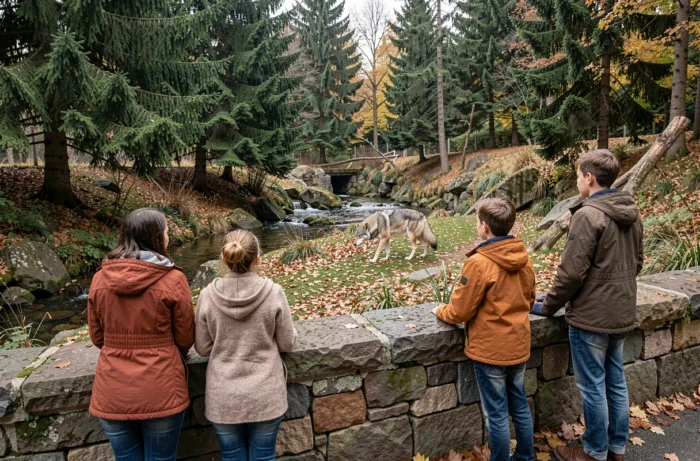
Mountain parks, in the Alps or the Pyrenees, host species adapted to altitude: wolves, raptors, and mid-mountain wildlife dominate the collections. The Maison des Loups, in the Pyrenees, allows observation of several distinct packs (wolves from Canada, Europe, Poland, and the Arctic).
This regional diversity makes the interactive map particularly relevant. Rather than searching for “zoo near me” and getting a generic result, filtering by region and type of animals refines the search towards a visit that corresponds to a true interest.
Beyond Entertainment: Refuges and Awareness
Some establishments listed on the maps are not zoos in the traditional sense. Refuges host animals seized by customs or abandoned by individuals. These structures play a distinct educational role, focused on the consequences of species trafficking and awareness activities.
The network of French animal parks evolves each year: new structures, closures, reconfigurations of enclosures, arrivals of species. A map that integrates these movements offers an updated snapshot of a sector where animal welfare is gradually redefining the visitor experience.