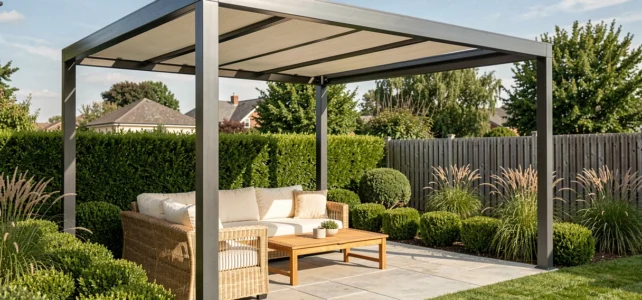
Installing a 4×3 aluminum pergola on your terrace means gaining an outdoor living space without major renovations. This 12 m² format covers enough area for a table for six people, a garden lounge, or a reading nook, without encroaching excessively on the garden. Choosing aluminum provides a lightweight structure that is weather-resistant and requires almost no maintenance.
4×3 Aluminum Pergola and Regulations: The Pitfall of Side Closures
Have you considered enclosing your pergola with glass walls to enjoy it even in autumn? This is precisely where the project changes its legal nature.
An open 4×3 pergola remains a classic outdoor arrangement. A prior declaration of works is sufficient in most cases. However, as soon as you add side closures creating an enclosed space of more than 5 m², the structure can be considered an extension of the house.
Decree No. 2026-200 of March 18, 2026, has broadened the scope of RE2020. Since July 1, 2026, certain constructions of less than 50 m² and extensions of less than 150 m² are affected as soon as a building permit or prior declaration is submitted. For a closed, heated, or open 4×3 aluminum pergola, a RE2020 certificate may be required even under 20 m².
Before purchasing, check your local urban planning plan. Some PLUs impose constraints on materials, colors, or maximum height of structures at property boundaries. A visit to the town hall takes half an hour and can save you months of procedures.
Among the models that meet these constraints while focusing on design, an elegant 4×3 aluminum pergola from Brico Dépôt allows you to combine a controlled budget with contemporary aesthetics.
Adjustable Slats or Fixed Roof: What Roof for a 4×3 Pergola
The choice of roof determines how you will use your pergola on a daily basis. There are two main categories, and they do not meet the same needs.
Bioclimatic Pergola with Adjustable Slats
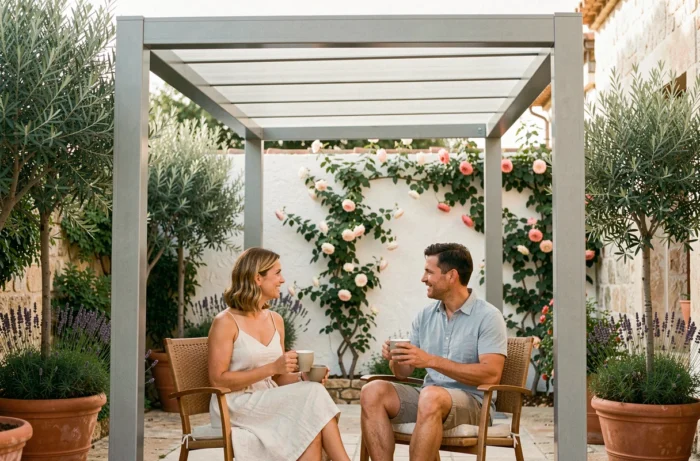
The adjustable slats pivot to modulate shade, brightness, and ventilation. When open, air circulates freely. When closed, they form a waterproof roof that protects from rain.
The motorization of the slats transforms the comfort of use. A simple switch or remote control allows you to adjust the orientation without getting up. Some models include weather sensors that automatically close the slats in case of rain.
The additional cost compared to a fixed roof is significant. Prices vary depending on the manufacturer, motorization, and finishes, but the difference is justified if you plan to use the pergola for several months a year in changing weather conditions.
Fixed Roof in Polycarbonate or Fabric
A fixed roof is suitable when the main goal is summer sun protection. Polycarbonate allows light to pass through while blocking UV rays. The retractable fabric offers a compromise: it can be folded away when you want to enjoy the open sky.
- Polycarbonate is resistant to hail and impacts but may yellow after several years of intense exposure
- The retractable fabric requires regular cleaning to prevent mold, especially in humid climates
- The adjustable slats combine ventilation, rain protection, and light management in a single system
For three-season use, adjustable slats remain the most versatile choice.
Attachment and Structure: Against a Wall or Freestanding for a 4×3 Format
The configuration of your land dictates the installation method. Each option has its technical constraints.
A wall-mounted pergola relies on the facade of the house. It requires a load-bearing wall in good condition, capable of supporting the attachments. The advantage is direct: two posts instead of four, which frees up ground space and facilitates movement.
A freestanding pergola rests on four independent posts. It can be placed anywhere in the garden, far from the house if needed. This freedom of positioning allows you to create a shaded island in the middle of a lawn or near a pool.
In both cases, the quality of the ground anchoring is crucial. Aluminum is lightweight, which is an advantage for handling, but makes the structure more sensitive to wind. Bolted fixing plates in a concrete slab or foundation blocks are recommended to ensure stability against gusts.
Customizing a 4×3 Aluminum Pergola: Shades, Lighting, and Colors
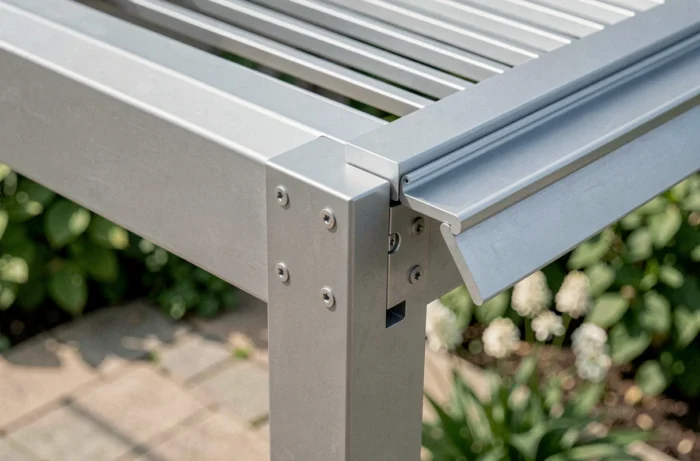
Aluminum lends itself particularly well to customization thanks to powder coating. This oven-cured painting process offers a wide range of shades (anthracite gray, white, black, wood effect) and is UV resistant without chipping.
Do you want to create an evening ambiance? The integration of LED spots into the beams or slats has become common. LED strips fit into the aluminum profiles without visible wiring, provided that electrical passage is planned from the start of the project.
- Retractable side shades protect from wind and prying eyes without completely enclosing the structure
- Gutters integrated into the posts drain rainwater invisibly
- A misting kit attached under the beams lowers the temperature by several degrees in the height of summer
Planning for electrical cable passage in the hollow posts before assembly avoids the need to drill into the structure afterward. This detail enhances the cleanliness of the installation.
The 4×3 aluminum format remains one of the best compromises between usable space, durability, and freedom of layout for a residential terrace. The real difference between an ordinary pergola and a successful one often lies in the finishes: integrated gutters, recessed lighting, color matching the facade. These details elevate the structure from a functional shelter to a natural extension of the home.