What truly distinguishes the wardrobe of the 1930s from that of the previous decade? The fashion of this era does not extend the Roaring Twenties: it contradicts them. Where the 1920s flattened the female silhouette, the 1930s restore the natural waist, lengthen skirts, and introduce materials that redefine the relationship between luxury and accessibility. This decade deserves a technical reading, not just an aesthetic one.
Materials of the 1930s: viscose, silk, and nylon, actual timeline
Articles on 1930s fashion often mix materials without distinguishing what truly belonged to the decade. A table helps clarify the timeline and actual use of each fiber.
| Material | Common Usage Period | Characteristics | Limitations |
|---|---|---|---|
| Natural Silk | All decade | Fluid drape, ideal for bias cut | High cost, reserved for evening gowns and haute couture |
| Viscose | All decade (mass use) | Imitation silk, accessible to all social classes | Fragile when washed, does not withstand heat well |
| Nylon (DuPont) | Announced in 1938, marketed late 1939 | Superior strength to natural fibers | Production too late to characterize the decade’s wardrobe |
Viscose is the material that best defines the democratization of 1930s style. It allows women outside the Parisian couture circles to access dresses with a drape comparable to that of silk. However, viscose required delicate care: no aggressive washing, no high-temperature ironing.
Nylon, often associated with the 1930s in competing articles, does not belong to the typical wardrobe of this decade. Nylon stockings only hit the market in May 1940. Attributing a significant role to it in 1930s fashion is an anachronism.
Among the 1930s trends on Ouvre Tête, this distinction between materials actually worn and still embryonic innovations is rarely made so clearly.

Bias Cut: Technique and Constraints of a 1930s Silhouette
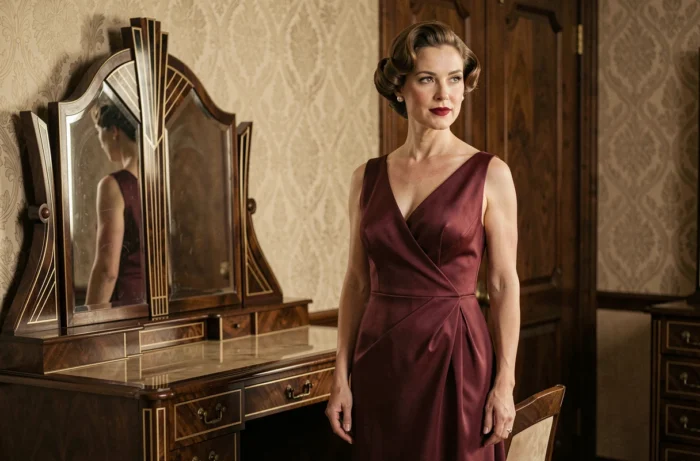
The bias cut is the technical gesture that summarizes the female silhouette of the decade. Popularized by Madeleine Vionnet in Paris, it involves cutting the fabric on its diagonal, which produces a fluid drape that hugs the body without resorting to rigid darts.
This technique is not just an aesthetic choice. It comes with concrete constraints that most retrospectives overlook:
- Fabric cut on the bias deforms over time, especially under its own weight. Dresses often had to be hung for several days before the final hem to allow the fabric to “fall” to its final length.
- The bias cut consumes significantly more fabric than a straight cut, making it a paradoxical luxury during an economic crisis.
- Fitting is more delicate: a poorly calculated alteration affects the drape of the entire garment, not just the corrected area.
This paradox between visual fluidity and technical demand explains why the bias cut remains associated with Parisian haute couture rather than the emerging ready-to-wear of the time. Evening gowns in silk cut on the bias embody the pinnacle of craftsmanship of the decade.
Female Silhouette and Daywear: What Women Really Wore
Hollywood cinema has fixed a very specific image of the woman of the 1930s in the collective imagination: long dresses, furs, jewelry. This image corresponds to evening wear and costume designs, not to everyday wardrobes.
The typical daywear combined a mid-calf skirt with a fitted blouse, often complemented by a short jacket or cardigan. The waist regained its natural position after a decade of straight silhouettes, and shoulders began to widen slightly, foreshadowing the shoulder pads that would dominate the 1940s.
Women’s trousers made their appearance in this decade, first worn by figures like Marlene Dietrich. The culotte also gained popularity, offering a compromise between practicality and social conventions. These garments remained marginal in everyday life but marked a symbolic break.
Accessories and Hats in 1930s Style
The hat remains a daily accessory for the majority of women. The styles of the decade are distinguished by their tilt to the side and their smaller shapes compared to those of previous years. The beret becomes a classic, worn with nonchalance.
Gloves, structured handbags, and medium-heeled shoes complete the day silhouette. Jewelry remains discreet during the day, reserving sparkle for evening attire.
Synthetic Fibers and Industrial Propaganda: An Overlooked Angle of 1930s Fashion
Fashion in the 1930s is not limited to Paris and Hollywood. Artificial fibers become a tool for political discourse. An industrial exhibition in Düsseldorf in 1937 showcased garments made from synthetic fibers produced by IG Farben, in a logic of German economic autarky.
Textile materials then served a discourse that went far beyond fashion. The stated goal was to demonstrate that a country could do without cotton or silk imports by developing its own fibers. This intersection of the textile industry and geopolitics is unique to this decade, long before fast fashion raised other questions about mass production.
This dimension reminds us that 1930s fashion is situated at a crossroads: between Parisian couture that perfects the bias cut and the industry that seeks to produce accessible clothing, even to instrumentalize textile fiber. The 1930s laid the foundations for modern ready-to-wear while remaining the golden age of demanding craftsmanship.
The wardrobe of this era continues to inspire contemporary collections, not out of nostalgia, but because the questions it raised (accessibility of materials, tension between luxury and mass production, role of clothing in public image) remain open.