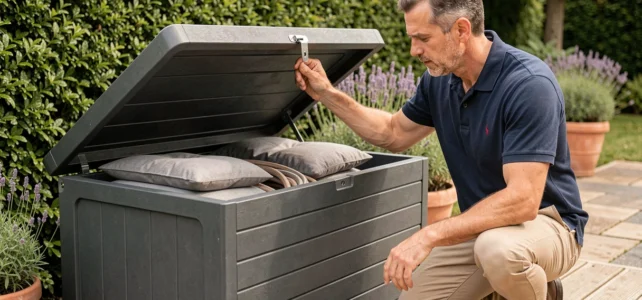
A garden chest that stays outside all year round is subjected to rain, frost, UV rays, and sometimes the weight of snow. Choosing the right model at Brico Dépôt is not just about comparing the liters of capacity displayed on the label. The material, the opening system, and even the shape of the lid radically affect the lifespan of the chest and the comfort of use on a daily basis.
Resin, wood, or metal: which material really withstands outdoor conditions
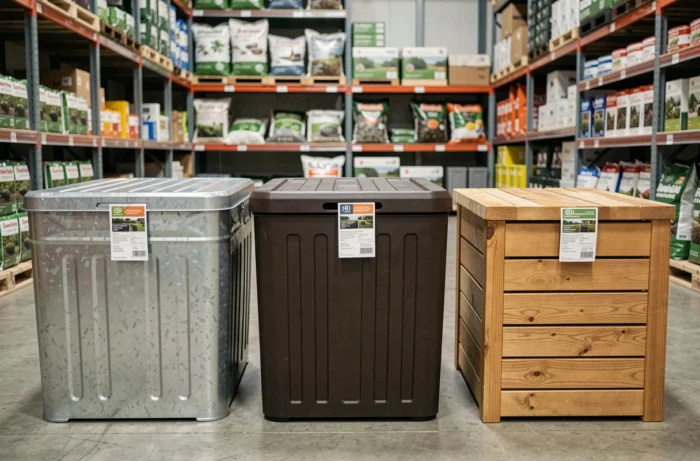
You may have noticed that some wooden chests turn gray after just one winter outside? Natural wood requires regular treatment (stain, saturator) to maintain its appearance and strength. In contrast, polypropylene resin, used by Keter in the majority of chests sold at Brico Dépôt, requires no maintenance. A quick blast of water is enough to clean it.
Metal (galvanized steel) offers very good mechanical resistance, but it heats up significantly in summer and can form condensation inside. This is a problem for storing cushions or textiles. Resin remains the best compromise for a chest exposed all year round, provided you check the thickness of the walls and the quality of the hinges.
Browsing the Brico Dépôt garden chest for outdoor use, it is clear that resin overwhelmingly dominates the catalog, with finishes that convincingly imitate wood (Keter’s Signature range, for example, with its oak appearance).
Waterproof garden chest: what the advertised waterproofing really means
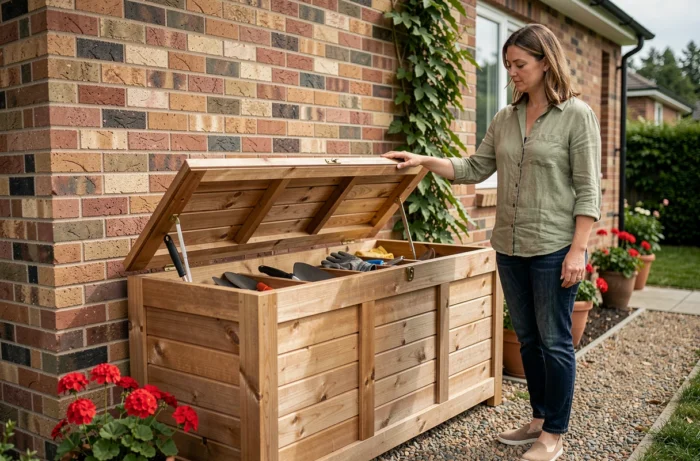
The term “waterproof” on a garden chest often leads to confusion. No chest with a hinged lid is completely airtight. The advertised waterproofing refers to the resistance of the walls and bottom to water infiltration, not the junction between the lid and the body.
What makes a difference in practice is the presence of a peripheral seal on the lid. Some Keter models incorporate a raised edge that prevents water from flowing inside. Others, in the entry-level ranges, only have a simple fitting without a seal.
If you plan to store garden lounge cushions or electrical equipment (extension cords, solar lighting), check two points before purchasing:
- The presence of a seal or waterproof lip around the entire perimeter of the lid, not just at the front
- A raised bottom compared to the ground, to avoid moisture rising by capillarity when the chest is placed on a slab
- A discreet ventilation system (micro-perforations on the sides) that limits internal condensation without letting rain in
A chest placed directly on soil or grass will always have more humidity issues than a chest installed on a hard surface. At a minimum, plan for blocks or a pallet if you don’t have a terrace.
Capacity and dimensions: adapting the chest to what you actually store
The displayed volumes range from a few hundred liters to over a thousand liters for the largest models. Before choosing the biggest one, ask yourself a simple question: what will go inside?
An oversized chest takes up unnecessary space on a small terrace. For cushions for a four-seat lounge and a few gardening tools, a medium-sized model is more than sufficient. Very large chests are justified when storing a lawnmower, a folding barbecue, or bulky children’s games.
Also consider the interior shape. Some chests have a flat bottom and straight walls that maximize usable volume. Others, with internal reinforcements or a curved bottom, lose some of their advertised capacity. Look at the internal dimensions, not just the volume in liters on the product sheet.
The chest as seating: a trend to check before purchase
More and more buyers use the chest as an extra bench, extending the garden lounge. Keter ranges like Signature or Cortina are designed to support the weight of several people sitting on the lid. A reinforced lid with internal ribs distinguishes a storage bench from a simple storage bin.
If this dual function interests you, test the rigidity of the lid in-store. A lid that flexes under moderate pressure will not hold up over time with users sitting on it regularly.
Assembly and locking: two often overlooked criteria
User feedback on Keter chests frequently mentions that assembly can be done alone, without tools, in less than an hour. This is a real advantage of resin compared to wood or metal, which often require screwing and drilling.
Check the panel fastening system. A clip and groove assembly without screws is faster, but also easier to disassemble if you move or change the layout of your terrace. Kit models with screws are stiffer, but disassembly can sometimes damage the fixing holes.
Locking is another point not to be overlooked. Most Brico Dépôt chests offer a place for a padlock, but the padlock is not included. Some models feature an integrated key or combination lock, which avoids the need to purchase an additional accessory. For a chest stored in a garden accessible from the street, a solid locking system makes the difference between storage and an outdoor safe.
- Chest with a simple loop for a padlock: suitable for a closed garden, sufficient to deter accidental opening
- Chest with an integrated key lock: recommended if the chest contains valuable equipment (power tools, lighting)
- Gas struts for the lid: they keep the lid open safely, a nice detail when storing heavy items with both hands
Choosing a garden chest at Brico Dépôt should be guided by actual use rather than just price. A well-sized chest, with a waterproof lid and tool-free assembly, will last much longer than a discounted XXL model that is poorly designed. Take the time to check the hinges, the lid seal, and the locking options before finalizing your purchase.