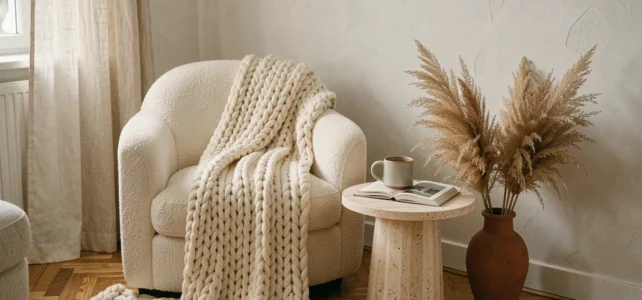
Cocooning is no longer limited to blankets piled on a sofa at the first sign of cold. The trend has expanded to all seasons, driven by a constant need for indoor comfort that remote work has amplified. Transforming your home into a warm cocoon requires understanding what has changed in the way we inhabit spaces, before choosing materials or colors.
Cocooning all year round: why cocoon decor is no longer seasonal
Most decor guides still associate warm cocooning with winter, candles, and dark hues. The trends for 2024-2026 described by players like Burov show a different reality: cocooning now extends to the warm months, featuring materials like natural linen, rattan, or sandy tones.
The idea is no longer to shield oneself from the cold, but to create a space where the body relaxes regardless of the weather. In summer, this involves lightweight yet enveloping textiles, soft light without heaviness, and light colors that maintain the feeling of being “contained” in a space designed for oneself.
This seasonal shift has a practical consequence: decoration choices must work for twelve months. A beautiful thick velvet in December becomes stifling in July. Mixed natural fibers (linen-cotton, cotton-jute) offer versatility that purely winter materials lack. Several specialized resources, including the home page of La Petite Déco, gather concrete ideas for adapting your interior to this four-season logic.

Hybrid workspace and cocoon decor: the constraints that guides overlook
Remote work has permanently changed the function of living spaces. A living room is no longer just a place to relax: it hosts video conferences, concentration sessions, and sometimes client calls. Classic decor articles almost always ignore this reality.
A warm cocoon compatible with working from home meets specific requirements that go beyond the choice of a cushion.
- Lighting must be soft enough to create a calming atmosphere while ensuring a good camera output during video conferences. Adjustable color temperature lamps (warm white in the evening, neutral white during workdays) resolve this conflict.
- The visual background of the makeshift office matters: an earthy-toned wall with a bookshelf or a few plants creates a neat backdrop without appearing cold or overly decorated.
- Acoustic comfort is often overlooked. A thick rug, heavy curtains, and a cushioned armchair not only serve the cocooning aesthetic: they absorb sound reverberations that can be tiring during long days at home.
Thinking of cocoon decor without integrating these functional constraints means decorating an interior that no longer matches how it is actually used.
Colors and materials for a cocoon interior: what works beyond trends
“Trendy” palettes change every year. Terracotta dominated, then sage green, then rosy beige. The enduring shades share a common point: they mimic natural materials. Stone color, clay, light wood, wet sand. These tones do not go out of style because they are not a trend, but a perceptual constant: the brain associates them with calm.
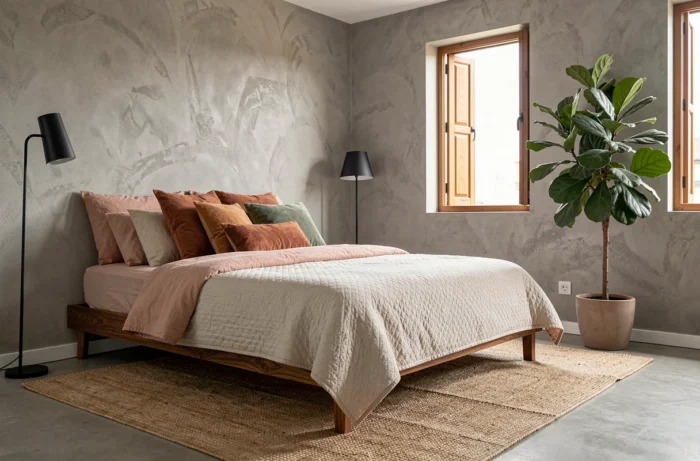
“Drenching,” a technique validated by professional decorators, involves applying the same shade to the walls, woodwork, and ceiling. The result creates an immediate enveloping effect, particularly effective in small rooms where color contrasts visually fragment the space.
Materials to prioritize based on the room’s use
In a versatile living room (for relaxation and work), fabrics with visible grain, such as crumpled linen or textured cotton, add texture without overwhelming. Texture matters more than color in creating a sense of warmth. A beige linen sofa with boucle wool cushions creates a more pronounced cocoon effect than a red sofa in smooth fabric.
For the bedroom, feedback converges towards layering: washed cotton sheets, fine wool blankets, and a gauze throw. This accumulation of light layers effectively replaces a single thick duvet and adapts better to nighttime temperature variations.
Micro-zones of relaxation: a cocoon decor principle more effective than the entire room
Trying to transform an entire room into a warm cocoon often encounters compromises (storage, circulation, natural light). A more realistic approach is to create identifiable micro-zones of relaxation in each room.
A deep armchair positioned near a window, with a table lamp and a small rug underfoot, constitutes a “micro-cocoon” that functions independently of the rest of the room. This logic aligns with observations on the link between localized comfort and reduced anxiety: having an identified retreat point in one’s own home acts as an anchor.
Natural elements enhance this effect. A green plant with cascading foliage, a raw wood bowl, an unscented candle (the flame is enough): three well-placed objects create a comfort zone stronger than a hastily redecorated room.
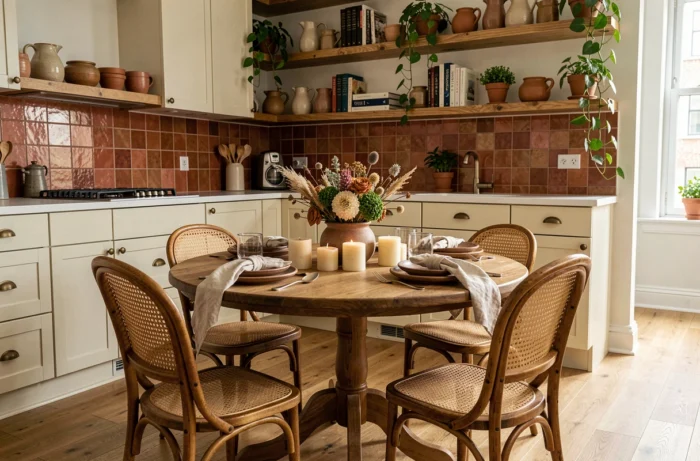
The most enduring warm cocoon is not the one that follows the year’s decor trends, but the one that responds to how we actually live at home, twelve months a year, between work and rest. Natural materials, adaptable light, and a few well-thought-out retreat zones do more than any complete makeover.