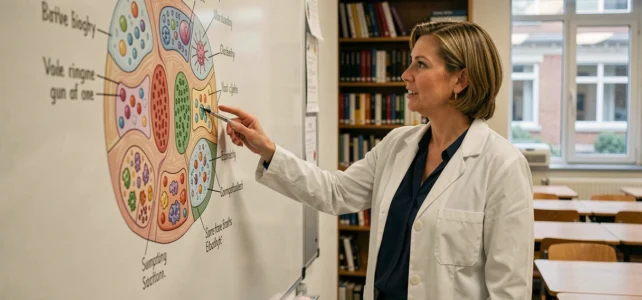
Sexual reproduction relies on two non-negotiable nuclear events: a chromosomal reduction through meiosis and a restoration of diploidy through fertilization. Everything else, gametic dimorphism, mating strategies, compatibility systems, stems from this haploid-diploid alternation.
Meiotic drivers and intragenomic conflicts during meiosis
Meiosis is presented as an equitable process where each allele has a one in two chance of joining the functional gamete. This view is incomplete. Selfish genetic elements called meiotic drivers bias meiotic segregation in many animal, plant, and fungal species, directly violating Mendel’s law.
Female meiosis amplifies the phenomenon. In most animal species, only one of the four meiotic products becomes a functional oocyte. So-called selfish centromeres manipulate their orientation on the achromatic spindle to increase their probability of ending up in that single viable oocyte.
These segregation distortions are not anecdotal. Recent syntheses show that they are common but underestimated, and that they influence the long-term evolution of genomes, population fertility, and potentially human health. Here we observe a structural paradox: the mechanism meant to ensure genetic mixing is itself a battleground among genomic elements.
To delve deeper into the mechanisms of sexual reproduction on Ma Vie de Famille, the distinction between theoretical segregation and actual segregation serves as a good starting point.
Anisogamy and male-female differentiation: why two types of gametes
The union of gametes imposes a fundamental constraint: limiting the number of cells that fuse to two. If three or more gametes were to fuse, the next meiosis could not properly restore haploidy. This mechanical constraint necessitates the diversification of gametes into two exclusive categories.
Anisogamy, the size dimorphism between male and female gametes, likely arises from an ancient system of chemical signaling between reproductive cells. The model proposed by several evolutionary biology studies works as follows:
- One type of gamete remains stationary and emits an attractive chemical signal into the surrounding medium.
- The other type of gamete responds to the signal and actively moves toward the source, optimizing the encounter.
- This system works optimally when the two categories are clearly distinct, one investing in nutrient reserves (large female gamete) and the other in mobility (small, flagellated male gamete).
The zygote resulting from this union acquires new properties that prevent it from fusing again with another gamete. It is this post-fertilization incompatibility that stabilizes diploidy and makes the sexual cycle functional.
Genetic mixing: crossing-over and independent segregation of homologous chromosomes
The genetic mixing produced by meiosis operates at two distinct levels that we must clearly separate.
Intrachromosomal mixing through crossing-over
During prophase I, homologous chromosomes pair up and exchange segments of chromatids. This recombination phenomenon generates recombinant chromatids carrying allele combinations absent in both parents. The frequency of crossing-over varies across chromosomal regions, meaning that not all genes are mixed with the same intensity.
Interchromosomal mixing through independent segregation
During anaphase I, the distribution of homologous chromosomes into the two daughter cells is random. Each pair of chromosomes separates independently of the others. For a species with n pairs of chromosomes, the number of possible gametic combinations reaches 2 to the power of n, not even counting the crossing-over.
Fertilization further multiplies this diversity by bringing together two gametes drawn from this combinatorial pool. The result: each individual resulting from sexual reproduction carries a statistically unique genotype.
Sexual reproduction versus asexual reproduction: the cost of males and the adaptive advantage
Sexual reproduction imposes a considerable cost. An asexual organism transmits its entire genome to each descendant, while a sexual organism transmits only half. This is what evolutionary biology refers to as the cost of males: in a mixed population, asexual lineages should theoretically outcompete sexual lineages within a few generations.
This is not what we observe. Sexual reproduction dominates among multicellular eukaryotes. Several non-exclusive hypotheses explain its persistence:
- Genetic mixing accelerates adaptation against parasites and pathogens, which evolve rapidly (Red Queen hypothesis).
- Recombination allows for the purging of accumulated deleterious mutations, which asexual reproduction cannot do effectively (Muller’s ratchet).
- The genetic diversity produced in each generation offers raw material for natural selection in the face of fluctuating environments.

The issue is not immediate reproductive performance but the ability of a lineage to persist over the long term. Strictly asexual species exist, but they often occupy stable ecological niches and exhibit higher extinction rates over geological timescales.
Sexual reproduction remains the dominant mode among animals and the vast majority of plants, not despite its cost, but because the genetic diversity it produces provides an evolutionary insurance that clonal multiplication cannot offer.